

Bad Credit Business Loans: How to Get Funded (Even with Poor Credit)
Introduction
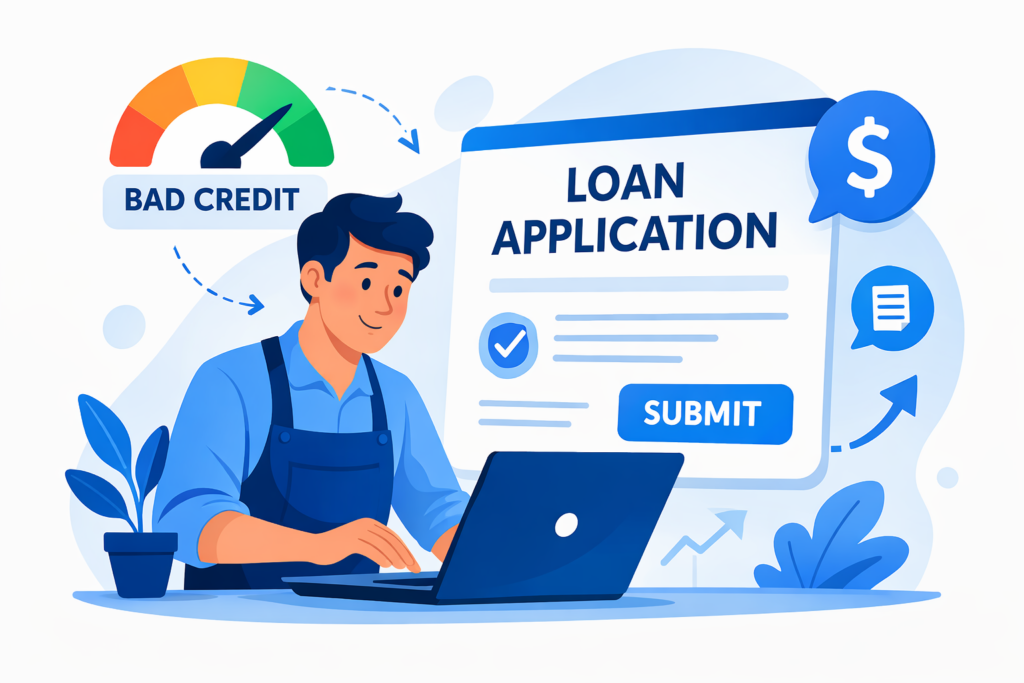
Your business is growing. You’ve got a solid plan, loyal customers, and real revenue. But when you look at your personal credit score, your heart sinks. Late payments from years ago, a maxed-out credit card, maybe some collections accounts – these financial mistakes from your past are now standing between you and the funding your business needs to thrive.
Here’s the truth that many struggling business owners don’t realize: bad credit doesn’t automatically disqualify you from getting a business loan.
While it’s true that traditional banks guard their lending criteria like Fort Knox, a rapidly growing segment of lenders has fundamentally changed how they evaluate business loan applications. These alternative lenders—merchant cash advance providers, online platforms, and specialized finance companies—focus on what your business is actually doing today rather than what your personal credit report says about yesterday.
According to recent studies, approximately 30-40% of small business owners have a personal credit score below 700, yet many of these same business owners successfully secure funding through alternative lending channels. The Federal Reserve’s Small Business Credit Survey found that alternative lenders approved roughly 60% of loan applications from businesses with limited credit histories or challenged credit profiles—a stark contrast to the less than 10% approval rate from traditional banks for the same demographic.
The reality is this: if you have a business generating revenue, there’s likely a lending option available to you. You may not love the terms, and you shouldn’t—having bad credit means higher risk to lenders, which translates to higher interest rates. But the funding door isn’t closed. It’s just opened by a different set of lenders with different criteria.
This guide will walk you through the landscape of bad credit business loans, showing you what options exist, what they cost, what credit score you actually need for each type, and most importantly, how to maximize your chances of approval.
Can You Get a Business Loan with Bad Credit?
Yes. Absolutely, yes.
The key to understanding this answer lies in what “bad credit” actually means in the context of business lending, and how different types of lenders evaluate applications.
What “Bad Credit” Means in Business Lending
When we say “bad credit,” we’re typically referring to a credit score below 650. Here’s the breakdown:
- Excellent: 750+
- Good: 700-749
- Fair: 650-699
- Bad: 550-649
- Poor: Below 550
But here’s where business lending gets interesting: your personal credit score isn’t the only number that matters. In fact, for many alternative lenders, it’s not even the primary number.
Traditional banks like your local Wells Fargo or Chase have underwriting models built around credit scores. They’ve been doing this for decades, and their risk models are based on historical data correlating credit scores to default rates. If you don’t meet their credit threshold (usually 680+), you won’t get past their automated system. It’s not personal; it’s just how their business model works.
Alternative lenders, however, operate differently. They’ve built their risk models around different data points:
- Cash flow and revenue (the strongest indicator)
- Bank account history (deposits, stability, patterns)
- Time in business (longer is better)
- Industry and business type (some industries are inherently riskier)
- Accounts receivable (for invoice factoring)
- Collateral value (for secured loans)
This shift in evaluation criteria has opened doors for thousands of business owners who were previously locked out of traditional financing.
Why Alternative Lenders Focus on Revenue Over Credit Score
Think about it from a lender’s perspective: if you’re making $50,000 a month in revenue despite having a 580 credit score, you’re actually a pretty reasonable lending risk. That monthly revenue is coming from real customers buying real products or services. You’re managing to keep the lights on. Yes, your personal financial management has been messy, but that doesn’t necessarily say much about your ability to manage your business finances.
Conversely, someone with a 750 credit score who isn’t generating business revenue is riskier from a cash advance or short-term loan perspective. The lender needs to know there’s cash flow to repay.
Alternative lenders use technology and data science to create sophisticated risk models that look at dozens of variables. They can afford to take on borrowers with lower credit scores because:
- They charge higher interest rates (reflecting the higher risk)
- They have faster repayment terms (meaning they get their money back quicker)
- They have better data on what actually predicts small business defaults
- They have more diversified portfolios that absorb losses better
Types of Lenders That Work with Bad Credit
Not all bad credit business loans are created equal. Here are the main types of lenders accessible to borrowers with poor credit:
Alternative Online Lenders: Companies like OnDeck, Fundbox, and similar platforms use algorithmic underwriting to approve loans in days. They typically don’t require perfect credit (many accept 550+ scores) and focus heavily on cash flow analysis.
Merchant Cash Advance Providers: These companies (including LendWiz) don’t lend in the traditional sense—they purchase your future credit card sales at a discount. Credit score requirements are often the lowest of any funding type.
Community Banks and Credit Unions: Many smaller institutions are more flexible than major national banks and willing to work with borrowers who have challenged credit if they can show strong current business performance.
Specialty Finance Companies: These focus on specific funding types like invoice factoring, equipment financing, or SBA lending. Each has different credit requirements based on their collateral or revenue assumptions.
Direct Funders: Some companies like LendWiz function as direct funders, lending their own capital rather than as brokers. This often means more flexible credit policies.
Best Business Loan Options for Bad Credit

If you have bad credit, not all funding options are equally accessible. Let’s break down the most viable options, ranked roughly by ease of approval with poor credit:
Merchant Cash Advance (Lowest Credit Requirements)
A merchant cash advance (MCA) is the most accessible funding option for businesses with poor credit. Here’s how it works:
Instead of borrowing money like a traditional loan, you’re selling a percentage of your future credit card sales to a cash advance provider. You receive a lump sum upfront, and the provider automatically deducts a percentage of your daily credit card transactions until the advance is repaid.
Credit Requirements: Many MCA providers will work with credit scores as low as 500, and some don’t check credit at all. Revenue matters far more than credit score.
Approval Timeline: 24-48 hours is typical.
Funding Speed: Often same-day or next-day.
Best For: Retail businesses, restaurants, e-commerce companies with strong credit card volume. Requires at least 3-6 months of credit card transaction history.
Cost: Factor rates typically range from 1.2x to 1.5x the advance amount. So a $10,000 advance might cost $12,000-$15,000 total repayment.
Pros: Fastest funding, minimal documentation, no minimum credit score, flexible repayment (tied to daily sales).
Cons: High effective interest rates (often 30-80% APR equivalent), takes a cut from your revenue, best for credit-card-heavy businesses.
Short-Term Business Loans
Short-term business loans typically have terms of 3-18 months and are designed for businesses needing quick capital for immediate needs.
Credit Requirements: Online lenders typically approve loans for borrowers with scores as low as 550, though rates improve at 600+.
Approval Timeline: 1-5 business days.
Funding Speed: 1-7 days after approval.
Best For: Businesses needing $5,000-$500,000 with strong recent revenue. Works for any business type.
Cost: Interest rates typically 15-40% APR, depending on credit score, revenue, and risk assessment.
Pros: Flexible use of funds, simple application process, fast approval, fixed repayment schedule.
Cons: Higher rates than traditional loans, shorter terms mean larger monthly payments, requires several months of bank statements.
Business Line of Credit
A business line of credit is a revolving credit facility—like a business credit card on steroids. You’re approved for a certain credit limit, and you only pay interest on what you actually use.
Credit Requirements: Most require 600+ credit score, though some alternative lenders will go down to 550.
Approval Timeline: 2-7 business days.
Funding Speed: Immediate access once approved.
Best For: Businesses with variable cash flow needs, seasonal businesses, managing cash flow gaps.
Cost: Interest rates typically 12-40% APR, often lower than term loans because you only pay interest on what you use.
Pros: Flexible access to capital, interest only on drawn amounts, can be reused after repayment, helps build business credit.
Cons: Requires stronger credit than some alternatives, may require personal guarantee, can be tempting to over-borrow.
Equipment Financing (Equipment as Collateral)
Equipment financing is a secured loan where the equipment you’re purchasing serves as collateral for the loan.
Credit Requirements: 600+ preferred, but some lenders will work with 550-600 scores because the equipment reduces their risk.
Approval Timeline: 3-7 business days.
Funding Speed: 5-10 days after approval.
Best For: Businesses needing to purchase equipment, machinery, vehicles, or tech infrastructure.
Cost: Interest rates typically 8-25% APR (often lower than unsecured loans because of the collateral).
Pros: Lower rates because of collateral, longer terms available (3-10 years), equipment grows in value (for some types).
Cons: Only for specific purchases, you don’t own the equipment until loan is repaid, risk of repossession.
Invoice Factoring (Credit of Your Customers Matters More)
Invoice factoring is selling your outstanding invoices to a factor at a discount. The factor collects directly from your customers, and you get the cash immediately.
Credit Requirements: Your personal credit matters less; your customers’ creditworthiness matters more. Many factors don’t check personal credit at all.
Approval Timeline: 1-3 business days.
Funding Speed: 24 hours after approval.
Best For: B2B service businesses with outstanding invoices to creditworthy customers. Must have invoices to factor.
Cost: Factoring fees typically 1-5% of invoice value per month (or 12-60% annually, depending on terms).
Pros: Immediate cash without waiting for payment, no credit check, risk transferred to factor, improves cash flow.
Cons: Customers know you’ve factored invoices (may affect relationships), reduced cash from each invoice, best for businesses with invoices, not all industries factor well.
Revenue-Based Financing
Revenue-based financing (RBF) is an increasingly popular option where investors provide capital in exchange for a percentage of monthly revenue until a predetermined amount has been repaid.
Credit Requirements: Many RBF providers don’t check credit at all, focusing solely on revenue and growth trajectory.
Approval Timeline: 3-7 business days.
Funding Speed: 5-14 days.
Best For: Businesses with consistent, predictable revenue of at least $10,000/month. Growing e-commerce, SaaS, and service companies.
Cost: You repay through a percentage of revenue (typically 2-10% of monthly revenue) until a cap is reached (often 1.3-1.5x the original investment).
Pros: No fixed payment amounts, payments scale with revenue, no collateral required, no credit check for many providers.
Cons: Reduces revenue for longer periods if you have slow months, companies sometimes resist outside parties seeing revenue data, may not work if revenue is highly variable.
What Credit Score Do You Need for a Business Loan?
Let’s cut through the noise and give you the actual numbers. Here’s what different types of lenders require:
| Lender Type | Minimum Credit Score | Preferred Range | Notes |
|---|---|---|---|
| Traditional Banks | 680+ | 700+ | Will decline below 680; sometimes require 700+ even |
| SBA Lenders | 650+ | 680+ | Some require higher for certain loan programs |
| Online Lenders | 550+ | 600+ | Many approve at 550, but better rates at 600+ |
| Merchant Cash Advance | 500-550 | No minimum | Many don’t check credit at all; revenue-focused |
| Equipment Financing | 580+ | 600+ | Collateral reduces requirements; some go lower |
| Invoice Factoring | No check | Customer credit matters | Personal credit often not checked |
| Revenue-Based Financing | No check | No requirement | Revenue is the only factor |
| Credit Unions | 600+ | 650+ | Varies by institution; often more flexible than banks |
| Direct Funders | 550+ | 600+ | Can vary significantly by company |
The Most Important Thing to Remember: Your credit score is just one of many factors. If you have:
- Consistent monthly revenue of $10,000+
- 6+ months of business history
- Regular bank deposits
- No current collections or bankruptcies
…you likely qualify for some form of business funding, regardless of your credit score.
Many online lenders and alternative financiers will give you a pre-qualification estimate without a hard credit inquiry, meaning you can see what you might qualify for without it affecting your credit score.
How to Get a Business Loan with Bad Credit (Step by Step)
The process of securing a business loan with bad credit is actually quite straightforward. Here’s exactly how to approach it:
Step 1: Know Your Credit Score
Before applying anywhere, know what you’re working with. Pull your credit reports from all three bureaus (Equifax, Experian, TransUnion) at annualcreditreport.com—this is free and doesn’t affect your score.
Look for:
- Errors (dispute anything inaccurate)
- Patterns (isolated late payments vs. chronic delinquency)
- Recent activity (lenders care more about recent history than old mistakes)
- Collections or charge-offs (these are bigger red flags)
Understanding your credit report helps you explain it to lenders and identify any errors you should dispute.
Step 2: Gather Your Bank Statements
This is critical. Most alternative lenders will want 3-6 months of business bank statements (many also want 2 months of personal bank statements if the business is young).
Why? They’re analyzing:
- Average monthly deposits (revenue)
- Consistency and stability of deposits
- Payment patterns (regular expenses, payroll stability)
- Current balance (shows you’re not in crisis)
- Any red flags (frequent overdrafts, late fees, unusual transfers)
Organize these cleanly. Export them as PDFs. Have them ready before you apply.
Step 3: Determine How Much You Need
Be realistic. Lenders can sense desperation, and over-borrowing causes problems. Calculate:
- Exactly what you need the funds for
- How much that costs
- What monthly payment you can actually afford
A general rule: if a monthly payment would take more than 30-35% of your monthly profit, it’s too much. You want to maintain healthy cash flow.
Step 4: Choose the Right Loan Type for Your Situation
This is crucial. Not all funding options work for all businesses. Ask yourself:
- Do you have strong credit card sales? → Merchant Cash Advance
- Do you have outstanding invoices? → Invoice Factoring
- Do you need equipment? → Equipment Financing
- Do you have consistent, strong revenue? → Revenue-Based Financing or Short-Term Loan
- Do you need flexible access to capital? → Line of Credit
- Is your revenue variable? → Line of Credit
Match the tool to your situation. Bad credit is challenging enough—don’t add the wrong funding type on top of that.
Step 5: Apply with the Right Lender
Not all lenders are equal. When evaluating where to apply:
Check their credit requirements – If they require 700+ and you’re at 580, don’t waste time.
Look at their typical approval timeline – You need money in days, not weeks.
Read actual reviews – Not just stars, but what people say about the process, hidden fees, and customer service.
Verify they’re legitimate – Check with the Better Business Bureau, look for physical office addresses, verify licensing.
Consider working with a broker – Companies like LendWiz connect you with multiple lenders, increasing your chances of approval and getting better terms.
Most legitimate lenders will give you a pre-qualification without a hard credit pull. Do this first to see what you might qualify for.
Step 6: Consider a Co-signer or Collateral
If you’re getting rejected, this is your backup plan:
Co-signer: If someone with good credit (spouse, partner, family member) will personally guarantee the loan, this dramatically improves your odds. Be aware: they’re personally liable if you don’t repay.
Collateral: Offering collateral (business equipment, inventory, real estate, vehicles) reduces the lender’s risk and often improves both approval odds and rates.
Only use these options if you’re confident in repayment. These are serious commitments.
Bad Credit Business Loan Rates & Costs
Let’s be honest about something: getting a loan with bad credit costs more money. This is the trade-off. You need to understand exactly how much more.
Rate Ranges by Loan Type
Merchant Cash Advances: 20-80% APR equivalent (expressed as a factor rate of 1.2x to 1.5x)
Short-Term Business Loans: 15-40% APR for bad credit (improves to 8-25% as credit improves)
Business Lines of Credit: 12-40% APR
Equipment Financing: 8-25% APR (lower because of collateral)
Invoice Factoring: 1-5% per month (12-60% annually)
Revenue-Based Financing: 1.3x to 1.5x repayment (varies, not expressed as traditional APR)
For context: A borrower with excellent credit might get a business loan at 8-10% APR. With bad credit, that same loan might be 25-35% APR. With a merchant cash advance, the costs are even higher.
How to Compare True Costs
Don’t just look at interest rates. You need to calculate the total cost of borrowing.
For a $20,000 short-term loan at 30% APR over 12 months:
- Total interest paid: ~$3,300
- True cost: $23,300
For a $20,000 merchant cash advance at 1.35x factor:
- Total repayment: $27,000
- True cost of capital: $7,000
The MCA is more expensive, but also faster to obtain and doesn’t require your personal credit check. The trade-off might be worth it if you need money immediately.
Always calculate:
- Total amount repaid
- Monthly payment size
- True APR equivalent
- How long until repaid
Use online loan calculators to compare different scenarios.
Ways to Lower Your Rate
You might not qualify for the best possible rates given your credit, but you can improve your offer:
Show stronger revenue trends. If you can demonstrate 3-6 months of growing revenue, lenders see you as less risky.
Offer a larger down payment. Putting 20-30% down reduces the lender’s exposure and often improves your rate.
Apply for less money. Smaller loans are less risky. If you need $50,000 but could start with $25,000, the rate on the smaller amount might be better.
Improve your credit score first. Even a 30-point improvement (from 570 to 600) can meaningfully improve available rates. If you have time, pay down credit card balances and let late payments age.
Use collateral. Secured loans have lower rates than unsecured. If you own business equipment or real estate, offering it as collateral can reduce your rate by 5-15%.
Find a co-signer. If someone with good credit will co-sign, rates improve significantly.
Work with a lender that specializes in bad credit. LendWiz, for example, specializes in connecting businesses with bad credit to the best available lenders for their situation. Specialized lenders often have better rates than generalist platforms.
“Guaranteed Approval” Business Loans: What You Should Know
If you’re searching for business loans with bad credit, you’ve probably seen ads promising “guaranteed approval.” Let’s talk about this honestly.
What “Guaranteed Approval” Really Means
When a lender claims “guaranteed approval” or “99% approval rate,” they’re either:
- Targeting a narrow audience (guaranteeing approval only for specific criteria, like $50k+ monthly revenue), or
- Being misleading (no legitimate lender can guarantee approval without evaluating your application)
No legitimate lender guarantees approval sight unseen. That’s not how credit works. Even alternative lenders have standards.
What they might mean:
- “High approval rate for businesses meeting our criteria”
- “Fast decision, usually approved or declined within 24 hours”
- “Minimal documentation required”
What “High Approval Rate” Actually Means
Reputable alternative lenders talk about approval rates. LendWiz, for example, has a higher approval rate than traditional banks, but it’s not 100% or 99%.
A high approval rate (70-80%+) means:
- The lender’s underwriting criteria are more flexible
- They’re willing to work with challenged credit if other factors are strong
- They have multiple loan products, so they can match most businesses with something
But it still means roughly 20-30% of applicants don’t qualify.
Red Flags to Watch For
Beware of lenders offering:
- Guaranteed approval with zero eligibility checks
- Loans where you prepay “processing fees” upfront
- Lenders that won’t disclose interest rates or fees upfront
- Requests for personal financial information via unsecured email
- Pressure to apply quickly or make decisions under time pressure
- Lenders that only communicate via phone, never in writing
- Interest rates that seem too good to be true (8% APR for a 550 credit score)
How Legitimate Lenders Evaluate Applications:
- Soft credit pull (doesn’t affect your score)
- Analysis of business bank statements (usually 3-6 months)
- Verification of business identity and structure
- Assessment of revenue and stability
- Evaluation against their specific underwriting criteria
- Clear disclosure of terms before approval
Legitimate lenders will want documentation, will be transparent about costs, and will have a legitimate underwriting process. If it feels sketchy, it probably is.
How to Improve Your Business Credit Score
While you’re seeking funding, start building for the future. Business credit scores are separate from personal credit (though they’re sometimes linked for newer businesses).
Key Steps to Build Business Credit
1. Separate Personal and Business Finances
Open a dedicated business bank account. Stop commingling personal and business money. Lenders analyze business bank statements separately, and this makes analysis much cleaner.
2. Pay Bills On Time
Set up automatic payments for recurring business expenses. Pay vendors and service providers by their due dates. Pay on time, every time. This is the single strongest factor in credit building.
3. Build a Trade History
Get business credit accounts with vendors who report to business credit bureaus (Dun & Bradstreet, Equifax Business, Experian Business). Even vendor accounts with terms (net-30, net-60) help. Build a history of timely payments.
4. Check Your Business Credit Reports
Like personal credit, business credit can have errors. Pull reports from Dun & Bradstreet (DUNS number required) and Experian Business. Look for errors and dispute anything inaccurate.
5. Keep Credit Utilization Low
If you have business credit cards or lines of credit, keep balances below 30% of available credit. This signals healthy credit management.
6. Reduce Outstanding Debt
Work to pay down business credit cards, loans, and other debt. Lower debt-to-income ratio improves your score and approval odds.
7. Register Your Business Properly
Make sure your business is properly registered (LLC, S-Corp, etc.), has its own EIN (Employer Identification Number), and has a clear business address. Lenders verify this.
Building Credit Takes Time (But It’s Worth It)
Business credit doesn’t build overnight. Realistically, you’re looking at:
- 3-6 months for basic credit establishment
- 6-12 months to have a meaningful credit score
- 12-24 months to have strong credit
But each month of positive payment history improves your profile. If you’re seeking funding now while bad credit is still an obstacle, while simultaneously working to build better credit, you’re covering both your immediate and future needs.
Tips to Increase Your Approval Odds
Beyond choosing the right lender and loan type, here are concrete tactics to improve your chances:
Provide Additional Documentation
Lenders are trying to assess risk. More information = more confidence. Provide:
- 6 months of bank statements (even if they only ask for 3)
- 2 years of tax returns (if available)
- Detailed P&L statements
- Customer contracts or letters of intent
- Sales pipeline information
- Industry analysis showing your market is strong
This tells the story of a business worth betting on.
Show Revenue Trends
If your revenue is flat, that’s okay. If it’s growing, highlight it. Create a simple spreadsheet showing:
- Monthly revenue for the last 6-12 months
- Growth trend
- Projected revenue (with realistic projections)
Lenders love seeing growth. It reduces their risk.
Apply for the Right Amount
Don’t ask for the maximum possible. Ask for what you actually need. If you need $25,000, ask for $25,000, not $50,000. Larger loans are riskier and have stricter requirements. Smaller loans for bad credit are easier to approve.
Choose the Right Loan Type for Your Situation
A business with $100,000 monthly credit card revenue is a perfect MCA candidate. But a B2B service company with invoices is better suited for invoice factoring. The right fit matters enormously.
Consider a Co-Signer
If you have a business partner, spouse, or family member with good credit willing to personally guarantee the loan, include them on the application. This dramatically improves your odds.
Work with a Broker or Specialist Lender
Companies like LendWiz work with multiple lenders, not just one. This means:
- They understand which lenders approve what
- They can match you with the best option
- You don’t waste time applying to inappropriate lenders
- They often have stronger negotiating power for better terms
Many brokers don’t charge you anything—they’re paid by the lenders.
How LendWiz Helps Businesses with Bad Credit

LendWiz operates differently than many online lenders. As both a broker connecting businesses to multiple lending partners and a direct funder offering its own capital, LendWiz is specifically designed to help businesses that traditional lenders turn away.
Multiple Lending Partners
Rather than trying to fit your business into one lender’s box, LendWiz connects you with multiple options:
- Merchant cash advance providers
- Short-term loan lenders
- Equipment financing specialists
- Invoice factoring companies
- Revenue-based financing partners
- Direct funding from LendWiz’s own capital
This means if you don’t qualify for one type of funding, there are others to explore.
Looking Beyond Credit Scores
LendWiz’s underwriting focuses on what matters: Can your business repay the loan?
They analyze:
- Current revenue and growth trends
- Cash flow patterns
- Business fundamentals
- Industry outlook
- Your commitment to the business
Yes, they pull your credit report, but it’s not the deciding factor. A business with bad personal credit but strong fundamentals can still qualify.
Speed and Simplicity
The application process is streamlined:
- Pre-qualification in minutes (no hard credit pull)
- Decision within 24-48 hours
- Minimal documentation
- Clear terms upfront
- Funding within days
Multiple Options Under One Roof
Rather than applying to five different lenders and getting declined four times, you apply once to LendWiz. Their job is matching you with the right lender and loan type. You get a single point of contact and clear guidance on your options.
This approach particularly benefits businesses with bad credit, where precision in matching to the right lender makes the difference between approval and rejection.
Frequently Asked Questions
Q: Will applying for a business loan hurt my personal credit score?
A: A soft credit inquiry (which many lenders use for pre-qualification) won’t hurt your score. A hard inquiry might reduce your score by 5-10 points temporarily. Multiple hard inquiries within 14 days usually count as one inquiry, so you can apply to multiple lenders without compounding damage. That said, do your shopping within a focused timeframe rather than over several months.
Q: Can I get a business loan without a personal credit check?
A: Yes, some lenders (like invoice factoring and revenue-based financing providers) don’t check personal credit at all. They focus entirely on business metrics. Merchant cash advance providers also typically don’t require strong personal credit.
Q: How much can I borrow with bad credit?
A: It depends on your revenue, time in business, and the lender, but generally expect $5,000-$100,000 ranges with bad credit (compared to $100,000-$500,000+ with good credit). Some lenders max out at $50,000 for bad credit borrowers. With very strong revenue, you might access more.
Q: How long does it take to get approved and funded?
A: This varies significantly by lender type. Merchant cash advances are fastest (24-48 hours to approval, often same-day funding). Short-term loans typically take 2-5 days to approval and 5-7 days to funding. Equipment financing and traditional SBA loans take longer (7-30+ days).
Q: Do I have to use collateral to get approved with bad credit?
A: Not necessarily. Merchant cash advances, invoice factoring, and revenue-based financing typically don’t require collateral. Short-term loans are usually unsecured. Offering collateral can help you get approved or get better rates, but isn’t always required.
Q: What happens if I can’t repay the loan?
A: This depends on the loan type and terms. With unsecured loans, the lender can pursue collection actions, damage your credit, and potentially sue. With secured loans, they can repossess the collateral. With MCAs, they stop deducting from your credit card sales. Always understand your obligations before signing.
Q: Can I use a business loan to pay off personal debt?
A: Legally, it depends on your business structure and lender terms. Generally, you should use business loans for business purposes. Some lenders explicitly prohibit using funds for personal debt. Check with your specific lender before using loan proceeds for personal obligations.
Q: Should I try to improve my credit score before applying for a business loan?
A: If you have time (3-6 months), yes. It will improve your options and rates. But don’t delay if you need funding now. Options exist for bad credit; they’re just not as favorable. You can apply now and re-finance later with better credit.
Q: What’s the difference between a business loan broker and a direct lender?
A: A broker connects you with multiple lenders but doesn’t lend their own money. A direct lender uses their own capital. Both can be legitimate. Brokers offer more options; direct lenders may be faster. LendWiz operates as both, giving you the benefits of each.
Q: How do I know if a lender is legitimate?
A: Check for physical office address, verify licensing with your state, read reviews on third-party sites, verify they disclose terms upfront, and be wary of guaranteed approval or upfront fees. Legitimate lenders will always provide clear written terms before you commit.
Don’t Let Bad Credit Hold Your Business Back — Apply Today
Your credit score is a number from your past. It doesn’t define your business’s future.
Yes, having bad credit makes accessing capital harder. The approval process takes longer, the rates are higher, and your options are narrower. That’s frustrating, and it’s completely understandable to feel discouraged.
But here’s what you need to know: thousands of business owners with bad credit successfully secure funding every month. They get capital to grow their businesses, invest in equipment, hire employees, and build the companies they envisioned. Their credit scores didn’t stop them.
You have options. Whether it’s a merchant cash advance, a short-term loan from an alternative lender, invoice factoring, equipment financing, or revenue-based capital, there’s likely a path forward for your business.
The question is: What’s holding you back from taking the next step?
If you’ve been told “no” by traditional banks, or if you’re uncertain what options you actually qualify for, contact LendWiz today for a free pre-qualification. Our specialists will honestly assess your situation, explain what you qualify for, and connect you with the best option for your business.
No judgment. No unnecessary complexity. Just real funding solutions for real businesses, even with less-than-perfect credit.
Your business doesn’t have time to wait while you obsess over your credit score. Get the capital you need today, and build better credit tomorrow.