

Introduction
Running a business means facing unexpected expenses, seasonal slowdowns, and sudden opportunities that require immediate capital. Unlike traditional term loans that give you a lump sum upfront, a business line of credit offers something different: flexible access to funds whenever you need them. Think of it as a safety net and growth tool combined.
A business line of credit works like a credit card for your company. You receive approval for a maximum credit limit, but you only borrow what you need and only pay interest on the amount you’ve actually drawn. Once you repay borrowed funds, that credit becomes available again—this is what makes it “revolving.” It’s the financial equivalent of having backup capital ready to deploy without going through lengthy reapplication processes each time.
For small business owners, managers, and entrepreneurs, this flexibility solves real problems. You can handle unexpected equipment failures, cover payroll during slow months, invest in inventory when prices are favorable, or launch a marketing campaign without disrupting your cash reserves. You’re not forced to take on more debt than necessary, and you’re not restricted by rigid repayment schedules that don’t match your business cycles.
In this guide, we’ll explore everything you need to know about business lines of credit: how they work, the different types available, requirements for qualifying, costs and rates, and how to determine if one is right for your business. Whether you’re managing seasonal cash flow challenges, planning growth, or building a financial safety net, understanding your options empowers you to make the right choice for your company.
What Is a Business Line of Credit?
A business line of credit is a flexible borrowing arrangement that gives your company access to a predetermined amount of capital. Instead of receiving funds all at once like a traditional loan, you access only what you need, when you need it. The lender sets a maximum credit limit—say $50,000 or $100,000—and you can draw against that limit multiple times.
Here’s the key difference from a term loan: with a revolving line of credit, once you repay borrowed funds, that credit resets and becomes available again. This is called “revolving” credit because the available balance revolves as you borrow and repay.
How the mechanics work:
During the “draw period” (typically 6 months to 3 years), you can access funds whenever needed. You might draw $10,000 one month for equipment, repay it three months later, then draw $25,000 for inventory. You only pay interest on the outstanding balance—the money you’ve actually borrowed.
Think of it this way: imagine you have a credit limit of $50,000. You draw $20,000 in January for supplies. You’re only charged interest on that $20,000. In February, you pay back $10,000, so your interest is now calculated on the remaining $10,000 balance. You’ve freed up $10,000 of credit line capacity that you can use again if needed.
Featured Snippet: A business line of credit is a renewable source of funding that allows businesses to borrow up to a set limit, repay the amount borrowed, and access those funds again—paying interest only on what you’ve actually drawn.
Comparison to term loans: A traditional term loan gives you all the money upfront in a single lump sum with fixed monthly payments regardless of how much you actually need. A line of credit gives you flexibility—you decide when to draw, how much to draw, and you only pay interest on active borrowing. Term loans are better for specific, one-time needs (like buying equipment). Lines of credit are better for ongoing, variable needs (like managing cash flow gaps).
How Does a Business Line of Credit Work?
Understanding the mechanics helps you use a line of credit effectively and avoid unnecessary costs.
The Setup Phase:
First, you apply with a lender. They evaluate your creditworthiness, business performance, and ability to repay. If approved, they set a credit limit—this is your maximum available borrowing. The lender also establishes your terms, including the draw period (how long you can access funds), the repayment period, interest rate, and any fees.
The Draw Period:
Once approved, you enter the “draw period.” This typically lasts 6 months to 3 years. During this time, you can access funds whenever needed. Most lenders allow draws through:
- Online banking portal
- Phone call
- Mobile app
- Check writing (for some lines of credit)
- Wire transfer requests
You might draw the full amount immediately, use it gradually over time, or access it in multiple smaller draws. The choice is yours.
The Repayment Structure:
During the draw period, you typically make interest-only payments on what you’ve borrowed. Once the draw period ends, you enter the “repayment period” (usually 3-10 years), where you repay both principal and interest in fixed monthly installments.
Real Example:
Let’s say you get approved for a $50,000 business line of credit at 12% annual interest with a 2-year draw period and 5-year repayment period.
- Month 1: You draw $20,000. Your monthly interest payment is approximately $200 (20,000 × 12% ÷ 12 months).
- Month 3: You draw another $10,000. Now you owe $30,000, so your monthly interest payment increases to $300.
- Month 4: You repay $15,000 of principal. Your outstanding balance drops to $15,000, and your interest payment decreases to $150.
- Month 8: You draw another $25,000. Your outstanding balance is now $40,000, and interest payments jump to $400 monthly.
Once the 2-year draw period ends, you stop making draws and begin paying fixed monthly installments that cover both principal and interest over the 5-year repayment period.
Interest Calculation:
Interest is typically calculated daily on your outstanding balance. If your line carries a 12% annual percentage rate (APR) and you have $25,000 outstanding, your daily interest is approximately ($25,000 × 0.12 ÷ 365) or about $8.22 per day. This accrues and is billed monthly.
Critical Advantage:
You only pay interest on what you’ve actually borrowed. If you’re approved for $50,000 but never draw more than $10,000, you only pay interest on that $10,000—not the full $50,000. This makes lines of credit more efficient than many other financing options for variable funding needs.
Types of Business Lines of Credit
Not all business lines of credit are the same. Understanding the different types helps you find the best fit for your specific situation.
Secured vs. Unsecured Business Lines of Credit
Unsecured Business Lines of Credit:
These require no collateral. Your approval is based on your credit score, business performance, revenue, and ability to repay. Because the lender assumes more risk, unsecured lines typically carry higher interest rates (often 8%-15% or higher depending on creditworthiness). However, they offer maximum flexibility since you’re not putting personal or business assets at risk.
Unsecured lines work well for businesses with strong credit and revenue history, or for those who can’t or won’t pledge collateral. Learn more about unsecured business loans to explore this option further.
Secured Business Lines of Credit:
These are backed by collateral—usually business assets like equipment, inventory, real estate, or accounts receivable. Because the lender has a claim to your assets if you default, they offer lower interest rates (often 5%-12%) and higher approval odds. However, you risk losing collateral if you can’t repay.
Secured lines require appraisal and legal documentation of the collateral, making the application longer. They work well for businesses with valuable assets and those seeking the lowest possible interest rates.
Revolving vs. Non-Revolving Lines of Credit
Revolving Lines:
These are the traditional business line of credit we’ve been discussing. As you repay borrowed funds, that credit becomes available again. You can borrow, repay, and borrow again multiple times during the draw period. Most lines of credit are revolving.
Non-Revolving Lines:
These work more like a term loan. Once you draw the funds, the credit doesn’t “reset.” You borrow once and then repay on a fixed schedule. Some lenders offer non-revolving lines with multiple draws allowed during the draw period, but once you repay a draw, that money doesn’t become available again.
Short-Term vs. Long-Term Business Lines of Credit
Short-Term Lines:
These typically have draw periods of 6-12 months and repayment periods of 1-2 years. They’re designed for immediate, urgent needs like seasonal cash flow gaps or quick inventory purchases. Interest rates may be higher, but you access capital rapidly.
Long-Term Lines:
These offer draw periods of 1-3 years and repayment periods of 3-10 years. They work for ongoing working capital management, growth initiatives, and situations where you need longer-term flexibility. Rates are typically more competitive than short-term options.
SBA Lines of Credit (CAPLines)
The Small Business Administration offers SBA CAPLines, which are guaranteed by the federal government. Lenders assume less risk because the SBA backs a portion of the loan. This makes approval easier and rates more favorable, though the application process is longer.
CAPLines types include:
- Seasonal CAPLines: For predictable seasonal needs
- Contract CAPLines: For businesses with large contracts requiring upfront expenses
- Working Capital CAPLines: For general operating expenses and inventory
- Export CAPLines: For businesses with export sales
SBA lines typically offer rates 2-3% lower than traditional unsecured lines, but require more documentation and take 4-8 weeks to close.
Business Line of Credit vs. Term Loan: Key Differences
Should you choose a line of credit or a traditional term loan? Here’s how they compare:
| Feature | Business Line of Credit | Term Loan |
|---|---|---|
| Funding Structure | Draw what you need, when you need it | Lump sum upfront |
| Repayment | Pay only interest on drawn amount during draw period | Fixed monthly payments from day one |
| Cost for Unused Funds | Nothing—you only pay interest on active borrowing | You pay interest on the full amount regardless of usage |
| Interest Rates | Often 8%-15% (varies by creditworthiness) | Often 6%-18% (varies by type and creditworthiness) |
| Time to Funds | Days to weeks for approval; funds available immediately | 1-3 weeks to close; funds disbursed once |
| Best For | Variable, unpredictable needs; cash flow management; ongoing access | Specific purchases; equipment; one-time expenses |
| Flexibility | High—draw and repay multiple times | Low—you have the money upfront, no additional draws |
| Application | Simpler, faster | More complex, longer timeline |
| Credit Impact | Initial hard inquiry; ongoing monitoring of available balance | Initial hard inquiry; impacts credit score based on utilization |
When to Choose a Line of Credit:
Choose a line of credit when you need flexibility, face variable expenses, want to pay only for what you use, or expect multiple funding needs over time. Perfect for managing seasonal cash flow, covering payroll gaps, emergency repairs, or rapid-response growth opportunities.
When to Choose a Term Loan:
Choose a term loan when you need a specific amount for a defined purpose, want predictable monthly payments, plan to use the full amount immediately, or prefer not having a rolling credit obligation. Ideal for purchasing equipment, real estate, or vehicles.
Many businesses use both: a term loan for a major equipment purchase and a line of credit for ongoing working capital needs.
Benefits of a Business Line of Credit
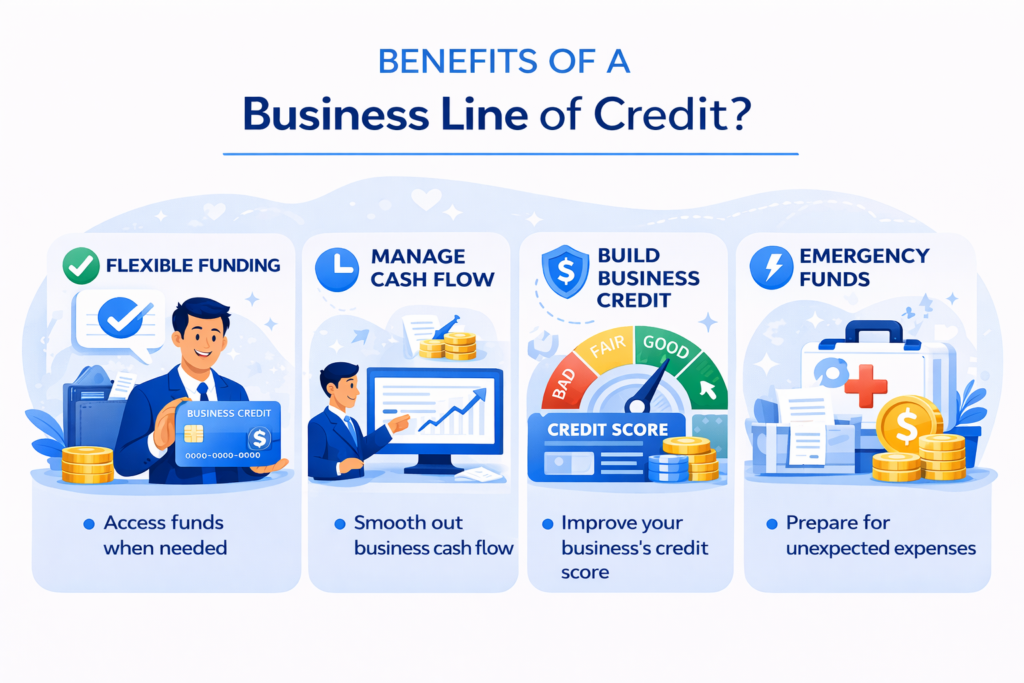
A business line of credit solves real problems that growing and established companies face.
Only Pay Interest on What You Use
This is the #1 advantage. You’re not financing more debt than necessary. If you’re approved for $50,000 but only need $15,000, you only pay interest on $15,000. No wasted interest payments on money sitting in your account. Over the course of a year, this saves thousands of dollars compared to taking a full-amount term loan.
Flexible Access to Capital
You control when you borrow and how much. Need $10,000 this month for marketing? Draw it. Next month needs nothing? Don’t draw. Three months later, need $30,000 for inventory? Draw it. This flexibility means you’re never stuck with borrowed capital you’re not using.
Build Business Credit History
Responsible use of a business line of credit demonstrates creditworthiness to future lenders. Paying on time, maintaining good credit utilization ratios (using less than 30% of your available credit), and managing the account properly strengthens your business credit profile. This makes future borrowing easier and cheaper.
Manage Cash Flow Gaps
Most businesses experience cash flow gaps—periods where expenses exceed income temporarily. A line of credit bridges these gaps. Retail businesses need inventory before holiday seasons. Service companies wait 30-60 days for client payments. A line of credit covers costs in between, keeping operations smooth.
Ready for Emergencies and Opportunities
Business doesn’t always go as planned. Equipment breaks unexpectedly. A major customer delays payment. A competitor goes out of business and their clients become available. A supplier offers a limited-time discount on bulk purchases. A line of credit means you’re ready to respond to emergencies and capitalize on opportunities without scrambling to find last-minute financing.
Reusable Credit (Revolving)
Once you repay borrowed funds, that credit is available again. You can use the same line of credit repeatedly over months and years. This beats taking out a new loan every time you need capital—no reapplication, no new credit inquiries, no repeated documentation.
No Requirement to Borrow
Unlike some financing arrangements, you’re not obligated to use your line of credit. Having it available costs nothing if you don’t draw on it (though some lenders charge annual fees whether you use the line or not). This peace-of-mind factor—knowing capital is available if needed—is valuable on its own.
Business Line of Credit Rates, Fees & Costs
Understanding the complete cost structure prevents surprises and helps you compare options accurately.
Interest Rates:
Business line of credit rates typically range from 5% to 15% APR, though rates can fall outside this range depending on creditworthiness, collateral, loan size, and market conditions.
Rate Determinants:
- Credit Score: Higher scores (700+) qualify for lower rates; lower scores (below 650) face higher rates or potential denial
- Revenue & Profitability: Stronger revenue histories support lower rates
- Collateral: Secured lines typically offer 2-4% better rates than unsecured
- Time in Business: Established businesses (3+ years) get better rates than startups
- Loan Size: Larger credit limits sometimes offer slightly better rates due to reduced administrative burden per dollar
- Lender Type: Banks offer competitive rates for strong borrowers; alternative lenders and MCA brokers may offer broader approval at higher rates
Common Fees:
| Fee Type | Cost | When Applied |
|---|---|---|
| Origination Fee | 1-5% of credit limit | Upfront, at approval |
| Annual/Maintenance Fee | $0-300+ | Yearly, whether you use the line or not |
| Draw Fee | $0-50 per draw | Each time you access funds |
| Early Repayment Fee | $0-500 | If you pay off before maturity (rare for lines) |
| Late Payment Fee | $25-100+ | If you miss payments |
| Insufficient Funds Fee | $25-75 | If a payment fails due to insufficient account balance |
| NSF Fee | $25-75 | Same as above; different name at some lenders |
Cost Example:
Let’s compare the true cost of a $40,000 line of credit at 10% annual interest versus a $40,000 term loan at 8% annual interest, both with 3-year repayment terms:
Line of Credit Scenario:
- Credit limit: $40,000
- You average using $25,000 over the 3 years
- Annual interest on $25,000 average: $2,500
- Origination fee (3%): $1,200
- Annual maintenance fee: $100/year × 3 = $300
- Total cost: ~$4,000
Term Loan Scenario:
- Loan amount: $40,000
- Fixed rate: 8%
- Fixed monthly payment: ~$1,257
- Total paid over 3 years: ~$45,252
- Interest portion: ~$5,252
- Total cost: ~$5,252
In this example, the line of credit saves money because you’re only financing $25,000 on average, not the full $40,000.
How to Minimize Costs:
- Only draw what you actually need
- Repay balances quickly to minimize interest accrual
- Compare origination fees across lenders (a 3% fee on one lender vs. a 1% fee at another makes a difference)
- Ask about waived annual fees for active accounts
- Maintain good credit to qualify for lower rates
- Consider secured options if you have collateral (lower rates)
Requirements for a Business Line of Credit
What do lenders look for when evaluating your application?
Credit Score Requirements:
- Excellent (750+): Best rates and highest limits; approval nearly certain
- Good (700-749): Competitive rates; approval likely with solid business fundamentals
- Fair (650-699): Approval possible; higher interest rates; may need collateral
- Poor (below 650): Approval challenging; may need strong alternative documentation; significantly higher rates
Your personal credit score matters if you’re a sole proprietorship. Your business credit score matters if you’re an LLC, corporation, or partnership. Many lenders review both.
Revenue Requirements:
Lenders want to confirm your business generates enough income to repay borrowed funds. Typical minimums:
- Established businesses: $100,000+ in annual revenue (some lenders go lower)
- Strong businesses: $250,000+ in annual revenue for higher limits ($50,000+)
- Startups or low-revenue: May be denied or offered very small limits (often through alternative lenders)
Time in Business:
- Less than 6 months: Very difficult to get approved
- 6 months-1 year: Possible, but limited; higher rates; smaller limits
- 1-2 years: Approval more likely; competitive options available
- 3+ years: Best options; competitive rates; higher limits
Documentation Needed:
To apply, prepare:
- Personal/Business Tax Returns: Last 2 years of personal returns (if you’re personally guaranteeing) and last 2 years of business tax returns
- Financial Statements: Recent (within 90 days) profit and loss statement and balance sheet
- Bank Statements: Last 3-6 months of business account statements showing cash flow patterns
- Business License/EIN: Proof you’re operating legally
- Identification: Driver’s license or passport for verification
- Articles of Organization: For LLCs and corporations
- Collateral Documentation: If applying for a secured line (property appraisals, equipment valuations, etc.)
- Personal Statement: For some alternative lenders
What Strengthens Your Application:
- Strong Personal and Business Credit: Demonstrates payment reliability
- Consistent Revenue Growth: Shows business momentum and stability
- Multiple Years of Tax Returns: Establishes business legitimacy
- Low Existing Debt: Improves debt-to-income ratio
- Strong Business Banking Relationship: Lenders favor accounts with consistent deposits and minimal overdrafts
- Collateral: Secured lines overcome credit weaknesses
- Industry Track Record: Longer time in business is always better
- Positive Gross Margin: Shows profitability, not just revenue
Building Your Case if You Have Challenges:
If you’re denied for a traditional lender, consider:
- Working with an alternative lender or MCA broker who focuses on working capital solutions
- Offering collateral to reduce lender risk
- Partnering with a co-signer who has stronger credit
- Waiting 6-12 months while you build stronger financials
- Starting with a smaller credit limit and demonstrating responsible use
How to Get a Business Line of Credit (Step by Step)
The process typically takes 1-4 weeks from application to funding. Here’s what to expect.
Step 1: Assess Your Needs
Determine how much capital you actually need and for what purpose. Don’t ask for more than you need just because it’s available. A $50,000 line of credit doesn’t help if you only need $15,000 and end up paying interest on funds you never use.
Ask yourself:
- What problems am I trying to solve? (cash flow gaps, growth, emergencies)
- How much capital do I realistically need?
- When will I need it? (immediately vs. ongoing)
- How quickly can I repay? (affects which product suits you best)
Step 2: Check Your Qualifications
Review your credit score (check your personal and business credit reports for errors). Gather your last 2 years of tax returns. Calculate your approximate annual revenue. Determine your time in business. This quick self-assessment helps you identify which lenders you qualify for.
Step 3: Gather Documentation
Compile all required paperwork now rather than rushing later:
- Personal and business tax returns (last 2 years)
- Recent financial statements (profit and loss, balance sheet)
- Last 3-6 months of bank statements
- Business license and EIN letter
- Articles of organization (if LLC/corporation)
- Driver’s license or passport
- Collateral documentation (if applicable)
Having everything ready speeds up the process significantly.
Step 4: Compare Your Options
Don’t apply everywhere—each application triggers a hard credit inquiry that slightly impacts your score. Instead, research 3-5 lenders that match your profile:
- Traditional Banks: Competitive rates, strict requirements, longer timelines (2-4 weeks)
- Credit Unions: Often offer member discounts, good rates, may be faster than banks
- Online Lenders: Faster approval and funding (1 week), broader approval criteria, potentially higher rates
- SBA Lenders: Best rates for qualifying borrowers, longer timeline (4-8 weeks)
- Alternative Lenders & MCA Brokers: Fastest approval for those with challenged credit or limited history; typically higher rates but more flexible
Compare interest rates, fees, draw periods, repayment terms, and approval timelines before applying.
Step 5: Apply
Complete the application with the lender you’ve chosen. Most online lenders offer online applications taking 15-20 minutes. You’ll provide basic information, financial overview, and the documentation they request.
Be honest and accurate. Misrepresenting your financials is loan fraud and can result in serious consequences.
Step 6: Approval and Underwriting
The lender reviews your application, pulls your credit report, verifies your information, and may contact your bank or reference customers. Underwriting typically takes 3-7 days. You may be asked for additional information or documentation.
Step 7: Receive Your Credit Line
Once approved, you receive documentation outlining your credit limit, interest rate, draw period, repayment terms, and access instructions. You’re now ready to use your line of credit.
Step 8: Draw Funds as Needed
Access your funds through your lender’s platform (online portal, phone, app, etc.). Funds typically appear in your account within 1-2 business days.
Throughout the Process:
- Respond promptly to lender requests
- Don’t apply for new credit (it raises red flags)
- Don’t close existing accounts (it can hurt your credit)
- Don’t make major purchases that would impact your debt-to-income ratio
- Be prepared for a verbal verification with the lender
Best Uses for a Business Line of Credit
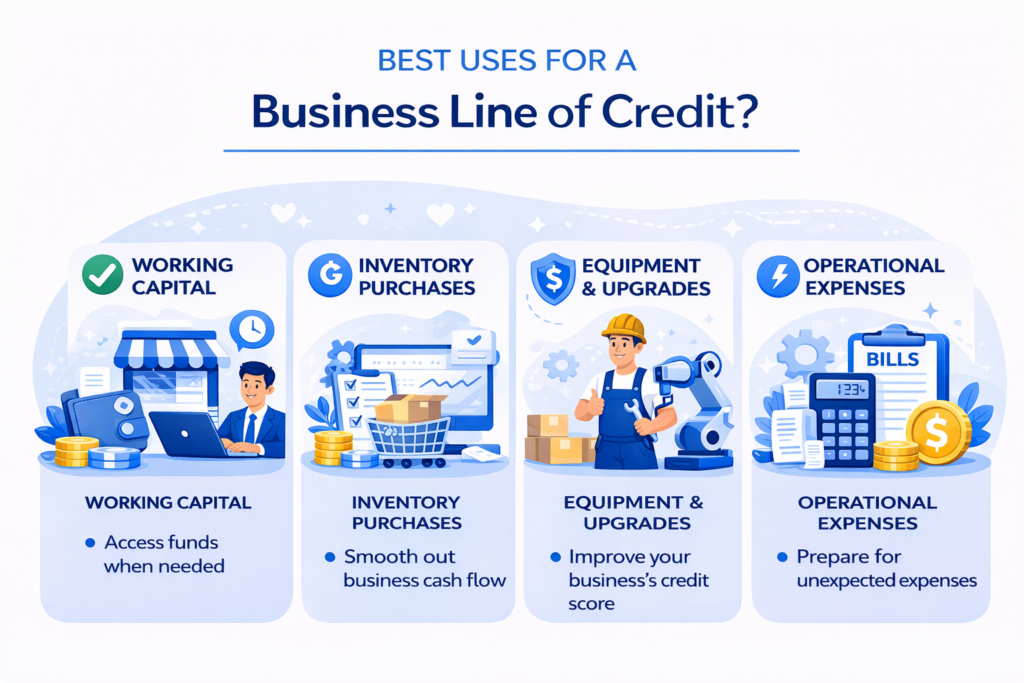
A business line of credit shines in specific situations. Here are the most common uses.
Managing Seasonal Cash Flow
Many businesses experience predictable seasonal patterns. Retail stores need inventory before holidays. Tax preparation firms are busiest in spring. Landscaping companies ramp up in summer. A line of credit covers the gap between major expenses and revenue spikes. You draw before the busy season, repay from the season’s profits, and the credit is ready again next year.
Covering Payroll During Slow Periods
Service-based businesses often have uneven revenue months. A line of credit ensures you can always meet payroll even during slow periods. This is critical because missing payroll destroys employee morale and may violate labor laws. Once cash flow improves, you repay the line.
Inventory Purchases
When a supplier offers limited-time volume discounts, ordering more than usual upfront can increase your profit margin. A line of credit lets you seize these opportunities without depleting your reserves. As you sell the inventory, the revenue repays the borrowed amount.
Marketing Campaigns
Launching a new marketing initiative—social media ads, direct mail, events—requires upfront investment before you see returns. A line of credit funds the campaign. Once new customers generate revenue, you repay the borrowed amount. This is especially valuable for growth-focused businesses.
Emergency Repairs and Replacements
Equipment breaks unexpectedly. Vehicles need major repairs. HVAC systems fail in the middle of winter. These aren’t budgeted expenses, but they’re critical. A line of credit covers the emergency, and you repay as cash flow allows. Better than going into shock over an unexpected $10,000 bill.
Bridging Invoice Payment Gaps
Many B2B businesses invoice clients on Net 30, Net 60, or Net 90 terms. You’ve already paid suppliers, but you’re waiting for client payments. A line of credit bridges this gap. Once clients pay, you repay the line. This keeps operations smooth despite longer payment terms.
Technology and Software Upgrades
Upgrading your point-of-sale system, accounting software, or website doesn’t have to wait for perfect cash positioning. A line of credit lets you invest in business improvements when strategically beneficial, then repay from improved cash flow or profits.
Hiring and Training
Bringing on new staff requires investment: training, onboarding, equipment setup. The new hire’s productivity takes time to reach full capacity. A line of credit covers the investment period, and increased team productivity repays the borrowed amount through higher output or revenue.
How LendWiz Makes Business Lines of Credit Easy
At LendWiz, we understand that finding the right financing shouldn’t be complicated. As a hybrid MCA broker and direct funder, we offer multiple pathways to capital.
Multiple Options
We work with traditional banks, online lenders, alternative funders, and SBA programs. We compare options specific to your situation and connect you with the best fit. Whether you need competitive rates with longer timelines or fast approval with flexible criteria, we have solutions.
Fast Approval and Funding
Our direct lending capabilities mean some applications can be approved within 24-48 hours, with funds in your account within days. No waiting weeks for traditional bank committees.
Competitive Rates
Because we work with multiple funding sources, we negotiate competitive rates across all credit profiles. Even if you don’t qualify for the best bank rates, we have alternatives that cost less than predatory options.
Simple Application Process
Our straightforward online application takes minutes. We ask for what we actually need, not documents we’ll never look at. Many applicants get approved the same day they apply.
Expert Guidance
Our team understands business financing. We explain your options clearly, compare scenarios, and help you choose the right product for your situation. We’re advisors, not just processors.
Flexible Eligibility
Whether you have strong credit or challenged credit, whether you’re an established business or a newer operation, we have programs designed for you. We look beyond credit scores to business fundamentals and potential.
Personalized Solutions
There’s no one-size-fits-all financing. We understand your specific situation and structure solutions accordingly. Whether you need working capital loans, a traditional business line of credit, or short-term business loans, we tailor the approach.
Frequently Asked Questions
1. Will getting a business line of credit hurt my credit score?
A hard credit inquiry will temporarily lower your score by a few points. However, responsible use of a line of credit actually improves your credit over time. Consistent, on-time payments and keeping your balance below 30% of your available credit demonstrates creditworthiness. The score hit is temporary; the credit-building benefit is long-term.
2. Can I get a business line of credit with bad credit?
Yes. While traditional banks require good credit (700+), alternative lenders and MCA brokers work with lower credit scores. You may face higher interest rates or need collateral, but approval is possible. Some lenders focus specifically on rebuilding credit through responsible line use.
3. What’s the difference between a business line of credit and a business credit card?
Both are revolving credit, but they differ significantly. A business credit card has a lower credit limit (typically $10,000-$50,000), higher interest rates (15%-25%), and is designed for smaller, short-term needs. A business line of credit offers higher limits ($25,000-$500,000+), lower rates, and is structured for business purposes. Lines of credit are more flexible; credit cards are more consumer-oriented.
4. How long does it take to get approved for a business line of credit?
Timeline varies by lender. Online alternative lenders and some direct funders approve in 24-48 hours. Traditional banks take 1-3 weeks. SBA lines take 4-8 weeks. LendWiz’s direct lending can approve same-day for qualified applicants.
5. Can a startup get a business line of credit?
Yes, though options are more limited. Most traditional lenders want 1-2 years of operating history. Some alternative lenders work with startups, especially if you have strong personal credit and can offer collateral. You might start with a smaller amount and build your credit limit over time.
6. What happens if I don’t use my business line of credit?
If you don’t draw, you pay no interest. However, you may be charged annual maintenance or usage fees (varies by lender). Some lenders waive annual fees if you maintain minimum activity (a small annual draw or payment). Having an unused line of credit is fine—it’s there when you need it.
7. Can I pay off my business line of credit early?
Yes. Most lines of credit don’t have prepayment penalties. You can repay your balance early without penalty, which reduces interest costs. Some lenders charge early repayment fees, so check your terms.
8. What’s the maximum amount I can borrow on a business line of credit?
Credit limits vary widely based on your creditworthiness, revenue, collateral, and the lender. A newer business might qualify for $10,000-$25,000. An established business with strong credit might qualify for $100,000+. Some commercial lines exceed $500,000. The lender determines your specific limit based on your profile.
Get Flexible Funding with a Business Line of Credit — Apply Today
A business line of credit provides the financial flexibility that growing businesses need. Whether you’re managing seasonal cash flow, covering unexpected expenses, or capitalizing on opportunities, having capital available on your terms makes a real difference.
The right line of credit gives you peace of mind, keeps your operations smooth, and empowers you to make business decisions based on opportunity rather than cash constraints.
Ready to explore your options? LendWiz makes it easy. Our team of financing experts can show you multiple solutions tailored to your specific situation—from competitive traditional lenders to flexible alternative programs. We’ll help you understand your options, compare real numbers, and get approved quickly.
Apply now and discover how much capital you can access. Whether you need $10,000 or $100,000, we have a solution for you. Get started with our simple online application—approval can happen as soon as today.