

Introduction
When it comes to financing a small business, few options rival the reliability and affordability of SBA loans. Backed by the U.S. government and issued through qualified lenders, SBA loans have become the gold standard of small business financing—offering lower interest rates, longer repayment terms, and larger loan amounts than most conventional business loans available today.
Since 1953, the Small Business Administration has helped millions of entrepreneurs and small business owners access the capital they need to start, grow, and scale their operations. Unlike government grants, SBA loans are actual loans that must be repaid, but the government’s guarantee to the lender means you benefit from more favorable terms and a higher approval chance than you’d get with a traditional bank loan alone.
However, navigating the SBA loan process can feel overwhelming. There are multiple loan programs to choose from, a lengthy application process, strict documentation requirements, and eligibility criteria that don’t always align with your expectations. That’s where this comprehensive guide comes in. We’ll break down everything you need to know about SBA loans—from the different types available to interest rates, requirements, and step-by-step application instructions—so you can make an informed decision about whether an SBA loan is the right financing solution for your business.
What Are SBA Loans?
How SBA Loans Work
An SBA loan is a business loan that’s partially guaranteed by the U.S. Small Business Administration. Here’s how the process works: You apply for a loan through an SBA-approved lender (such as a bank, credit union, or online lender). The lender underwrites and approves your application based on your creditworthiness, business financials, and ability to repay. Once approved, the lender disburses the funds to your business.
The critical difference between an SBA loan and a conventional loan is the government guarantee. The SBA doesn’t lend money directly to small business owners—instead, it guarantees a percentage of the loan (typically 75-90%) to approved lenders. This guarantee means if you default on the loan, the government will reimburse the lender for the guaranteed portion. For lenders, this significantly reduces their risk, allowing them to offer more favorable terms to small business borrowers who might not otherwise qualify for conventional financing.
From a borrower’s perspective, this government backing translates into several tangible benefits: lower interest rates (since the lender’s risk is reduced), longer repayment terms (often up to 10 years or more), higher loan amounts (up to $5.5 million for some programs), and broader acceptance of business types and credit profiles. You’re not getting free money—you’re still responsible for the full loan balance—but you’re getting significantly better terms than you’d likely qualify for elsewhere.
Why SBA Loans Are Considered the Best Business Loans Available
SBA loans have earned their reputation as the gold standard of small business financing for several compelling reasons:
Lower Interest Rates: Because the government guarantees a portion of the loan, lenders can afford to offer interest rates that are typically 2-4 percentage points lower than conventional business loans. For a $250,000 loan over 10 years, this savings can amount to tens of thousands of dollars in interest.
Longer Repayment Terms: SBA loans typically offer 5-10 year terms, with some programs extending to 20+ years. This longer timeline reduces your monthly payment burden and gives your business more breathing room as it grows.
Higher Approval Rates: Because of the government guarantee, lenders are more willing to work with borrowers who have imperfect credit, limited business history, or unique circumstances. Many borrowers who are rejected for traditional bank loans successfully qualify for SBA loans.
Larger Loan Amounts: Depending on the program, you can borrow up to $5.5 million with an SBA loan—far more than most online lenders or alternative funders will offer.
Purpose Flexibility: Many SBA loans allow broad use of funds, including working capital, equipment purchases, real estate acquisition, inventory, debt refinancing, and even franchise purchases.
Building Business Credit: Successfully managing an SBA loan helps establish your business’s credit profile, making it easier to qualify for conventional financing in the future.
Brief History and Purpose of the SBA Program
The Small Business Administration was established in 1953 as an independent agency of the federal government with a clear mission: to aid, counsel, assist, and protect the interests of small business concerns. Recognizing that small businesses are the backbone of the American economy—creating jobs, driving innovation, and building communities—the government created the SBA loan guarantee program to make it easier for entrepreneurs to access affordable capital.
Throughout the decades, the SBA has expanded its lending programs to address different needs: 7(a) loans for general business purposes, 504 loans for real estate and equipment, microloans for emerging businesses, and disaster loans for businesses affected by natural calamities. During economic crises, the SBA has dramatically expanded its lending to support business continuity. For example, during the 2008 financial crisis and the 2020 pandemic, the SBA surged lending and modified programs to get money into the hands of struggling business owners quickly.
Today, the SBA loan program remains one of the most effective—and cost-efficient—federal programs for supporting small business. The SBA doesn’t have to appropriate huge budgets because losses are relatively low; most small business owners take their loans seriously and repay them responsibly.
Types of SBA Loans
Not all SBA loans are the same. The program offers several distinct loan products, each designed for different business needs and situations. Understanding the differences will help you determine which loan type makes the most sense for your business.
SBA 7(a) Loans
Overview: The SBA 7(a) loan is the most popular and versatile SBA loan program. Established in 1953, it’s the foundation of the SBA’s lending portfolio.
Maximum Loan Amount: Up to $5 million (with standard guarantees), though average loans are typically $350,000-$500,000.
Loan Term: 5-25 years, depending on the use of funds. Working capital loans typically have 5-7 year terms, while equipment and real estate loans can extend to 25 years.
Interest Rates: Prime rate + 2.25-2.75% lender markup (rates vary based on loan size and lender pricing).
Acceptable Uses: Extremely broad. You can use 7(a) loan funds for:
- Working capital and cash flow needs
- Equipment and machinery purchases
- Real estate acquisition or improvement
- Inventory purchases
- Debt refinancing
- Franchise purchases
- Leasehold improvements
- Startup costs
What’s NOT Allowed: You cannot use 7(a) loans for investment in other businesses, purchasing real estate for investment (only owner-occupied), direct charitable giving, or gambling-related activities.
Guarantee: The SBA guarantees up to 90% of loans under $150,000 and 75% for loans over $150,000.
Why It’s Popular: The 7(a) loan’s popularity stems from its flexibility. Whether you need a small working capital boost or a large real estate purchase, the 7(a) program likely has you covered. It’s the program most small business owners think of when they consider an “SBA loan.”
Best For: Established small businesses with 2+ years of operation seeking a term loan for various business purposes.
SBA 504 Loans
Overview: The SBA 504 program is a specialized loan designed specifically for real estate and equipment financing.
Maximum Loan Amount: Up to $5.5 million (standard limit; higher for manufacturing or green businesses).
Structure: Unlike the 7(a) loan, which is a single disbursement, the 504 is a two-tier program:
- First Mortgage (50% of project cost): From a traditional lender at conventional rates
- SBA Loan (40% of project cost, up to $5 million): From a Certified Development Company (CDC) at fixed rates backed by SBA guarantee
- Owner Equity (10% of project cost): Your personal investment
Loan Term: 10-25 years (longer than 7(a) loans), with fixed interest rates throughout the loan period.
Interest Rates: Fixed rates, typically 1-2 points above 10-year Treasury rates. The fixed-rate feature is a major advantage if you’re concerned about interest rate increases.
Acceptable Uses: Limited to tangible assets:
- Real estate acquisition (owner-occupied commercial property)
- Building construction or renovation
- Equipment and machinery purchases
- Furniture and fixtures
- Leasehold improvements
What’s NOT Allowed: Working capital, inventory, debt refinancing, or intangible assets.
Guarantee: The SBA guarantees 100% of the CDC’s loan.
Why It’s Popular for Real Estate: If you need to purchase or expand your business location, the 504’s fixed rates and 25-year terms result in significantly lower monthly payments compared to conventional real estate loans.
Best For: Businesses specifically looking to purchase or improve owner-occupied commercial real estate or equipment.
SBA Microloans
Overview: The SBA Microloan program provides smaller loans to startups and growing small businesses, often when they’ve been turned down by traditional lenders.
Maximum Loan Amount: Up to $50,000 (average is around $13,000).
Loan Term: Generally 3-6 years.
Interest Rates: 8-13% (higher than 7(a) loans, reflecting the increased risk of smaller businesses).
Acceptable Uses:
- Working capital
- Inventory and supplies
- Equipment and machinery
- Furniture and fixtures
- Leasehold improvements
What’s NOT Allowed: Real estate and debt refinancing.
Guarantee: No SBA guarantee. Microloans are managed by nonprofit intermediaries and represent the lender’s direct risk.
Additional Requirements: Most Microloan programs require participation in business training and counseling (free or low-cost).
Why It’s Valuable for Startups: The Microloan program fills a critical gap. If you’re a startup with little business history and a small capital need, you won’t qualify for a 7(a) loan. A Microloan offers government-backed access to capital when traditional lenders won’t consider you.
Best For: Startups, minority-owned businesses, women-owned businesses, and small borrowers requiring up to $50,000.
SBA Express Loans
Overview: The SBA Express program is an expedited version of the 7(a) loan, designed for speed.
Maximum Loan Amount: Up to $500,000.
Loan Term: 5-10 years (shorter than standard 7(a) loans).
Interest Rates: Typically 0.25-0.5% higher than standard 7(a) loans (the premium you pay for faster approval).
Guarantee: 50% guarantee (lower than standard 7(a), which is why lenders can approve faster).
Approval Timeline: 24-36 days (compared to 30-90 days for standard 7(a)).
Acceptable Uses: Same as 7(a) loans—broad business purposes allowed.
Why Choose Express? If you need capital quickly and can accept a shorter term and slightly higher rate in exchange for faster approval, Express is worth considering. However, the reduced guarantee means some lenders may have stricter requirements.
Best For: Small to mid-sized businesses needing capital quickly and borrowing $500,000 or less.
SBA Disaster Loans (EIDL)
Overview: When disaster strikes—natural disasters like hurricanes or floods, or economic disasters like the 2020 pandemic—the SBA provides low-interest loans to help businesses recover.
Maximum Loan Amount: Up to $2 million for physical damage or economic injury.
Interest Rates: 3-4% (among the lowest available).
Loan Term: Up to 30 years.
Guarantee: Direct SBA loans (not guaranteed loans). The SBA lends the money directly.
Eligibility: Must be located in a declared disaster area or economic injury area.
Best For: Businesses recovering from natural disasters or economic emergencies.
SBA CAPLines
Overview: CAPLines are lines of credit designed for working capital and inventory needs.
Maximum Loan Amount: Up to $5 million.
Structure: Revolving line of credit (draw, repay, redraw).
Types:
- Seasonal Line: For predictable seasonal working capital needs
- Contract Line: To finance accounts receivable from specific customers
- Inventory Line: To finance inventory buildup
- Working Capital Line: General working capital needs
Interest Rates: Variable rates (Prime + spread), typically lower than unsecured credit lines.
Best For: Established businesses with predictable seasonal patterns or inventory cycles.
Comparison Table: All SBA Loan Types
| Feature | 7(a) Loan | 504 Loan | Microloan | Express | CAPLines |
|---|---|---|---|---|---|
| Max Amount | $5M | $5.5M | $50K | $500K | $5M |
| Best For | General Purpose | Real Estate/Equipment | Startups | Speed | Working Capital |
| Term Length | 5-25 years | 10-25 years | 3-6 years | 5-10 years | Variable |
| Interest Rate | Prime+2.25-2.75% | Fixed | 8-13% | Prime+2.5-3% | Prime+spread |
| Approval Time | 30-90 days | 45-90 days | 30-60 days | 24-36 days | 30-60 days |
| Best Use | Flexible | Real Estate | Startups | Quick Approval | Credit Line |
SBA Loan Requirements
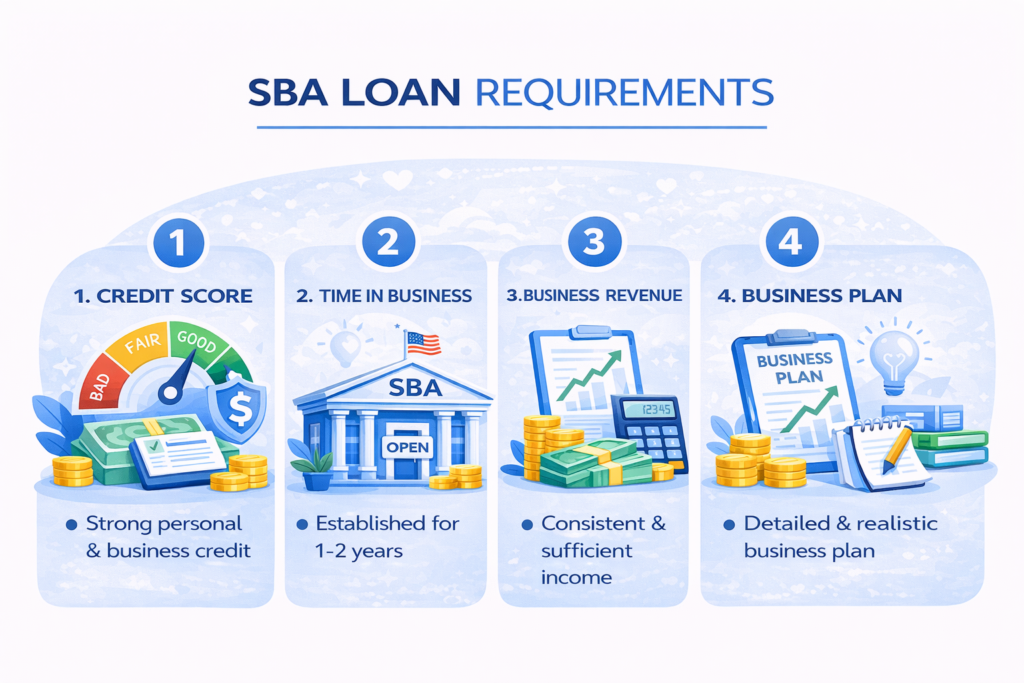
Understanding SBA loan requirements is critical before you invest time in an application. While SBA loans are more flexible than conventional bank loans, they’re not available to everyone. Here’s what you need to know about qualification criteria.
Credit Score Requirements
Minimum Score: Most SBA-approved lenders require a personal credit score of at least 650, though some will work with scores as low as 620.
What This Means: A 650 credit score isn’t perfect, but it shows you have some credit history and manage your obligations. This is significantly lower than the 700+ that many banks require for conventional business loans.
Impact on Approval and Rates: Your credit score affects both approval odds and interest rates. A score of 680+ significantly improves approval chances. A score below 650 makes approval harder but not impossible. Higher scores (750+) result in better interest rates.
How to Improve Your Score Before Applying:
- Pay down existing balances (aim for under 30% utilization)
- Make all payments on time for at least 6 months
- Dispute any errors on your credit report
- Avoid opening new credit accounts right before applying
Time in Business
Requirement: Most lenders prefer you’ve been in business for at least 2 years. Some programs allow 1.5 years, and Microloans/startups may have different standards.
Why It Matters: Lenders want to see that you’ve managed a business through at least one full business cycle and have historical financial data to review.
Exception: Startups can access Microloans and some SBA 7(a) programs, though qualification is harder and rates may be higher.
Revenue Requirements
Minimum Revenue: Typically $100,000+ in annual revenue is required, though this varies by lender and loan type. Some Microloan lenders accept businesses with lower revenue if other factors are strong.
What They’re Looking For: Lenders want proof your business generates sufficient revenue to support the monthly loan payment. A basic rule of thumb: your loan payment should be no more than 25-30% of your monthly business profit.
Documentation: You’ll need to provide 2-3 years of business tax returns and recent bank statements to demonstrate revenue history.
Business Plan Needs
Written Business Plan: Most SBA loans require a business plan, though the format and depth vary by lender and loan size. For loans under $50,000, a simpler plan may suffice. For loans $250,000+, lenders typically want a detailed plan.
What Should Be Included:
- Executive summary
- Company description and ownership structure
- Market analysis and competition
- Products/services description
- Marketing and sales strategy
- Management team details
- 3-year financial projections
- Use of loan proceeds (detailed breakdown)
Good News: Many SBA lenders provide templates or can guide you through what they need. You don’t need to hire a consultant—just be thorough and realistic.
Collateral Requirements
SBA 7(a) and 504: Collateral is typically required, though the SBA allows lenders to make loans without perfect collateral matches if other factors are strong. Acceptable collateral includes:
- Business equipment and machinery
- Accounts receivable
- Inventory
- Real estate (for 504 loans, real estate is the collateral)
- Business assets
Personal Guarantee: All principals owning 20%+ of the business must sign a personal guarantee, making them personally liable for the loan. This is non-negotiable.
Microloans: Collateral requirements vary by microlender but are often more flexible since these are riskier loans.
What You Should Know: Even if you have weak collateral, you may still qualify if other factors (revenue, credit, experience) are strong. Conversely, strong collateral doesn’t guarantee approval.
Industry Restrictions
Generally Acceptable Industries: Manufacturing, retail, services, construction, hospitality, professional services, transportation, healthcare, and technology companies.
Restricted Industries:
- Gambling-related businesses
- Lending and finance businesses
- Real estate investment (properties held for investment only, not owner-occupied)
- Nonprofits (with rare exceptions)
- Liquor and tobacco wholesale/retail (some restrictions apply)
- Adult entertainment
- Speculative businesses
What to Check: If your business falls into a gray area, contact an SBA-approved lender early to confirm eligibility.
Personal Guarantee
Non-Negotiable Requirement: Anyone owning 20% or more of the business must sign a personal guarantee.
What This Means: If your business defaults on the loan, the lender can pursue your personal assets (home, car, savings) to recover the debt. This is a serious commitment.
Protecting Yourself: Before guaranteeing a loan, ensure your business projections are solid and you’re confident in the business’s ability to service the debt.
SBA Loan Interest Rates & Terms
Understanding how SBA loan rates work—and what determines them—is essential for comparing loan offers and budgeting accurately.
Current Rate Ranges in 2026
SBA 7(a) Loans: Prime Rate + 2.25-2.75% markup
- Current typical range: 10.5-11.5% (assuming Prime is around 8.25%)
- Can vary up to 12% or higher depending on loan size and lender
SBA 504 Loans: Fixed rates tied to 10-year Treasury + 2.5-3%
- Current typical range: 7.5-8.5% (fixed for life of loan)
SBA Microloans: 8-13% (fixed)
SBA Express: Prime + 2.5-3% (slightly higher than standard 7(a))
SBA Disaster Loans: 3-4% (lowest available)
Note: These rates assume strong credit. Borrowers with credit below 650 may see rates 1-2% higher.
How Rates Are Determined
Base Rate: Most SBA loans use the Prime Rate as the base. The Prime Rate is the interest rate banks charge their most creditworthy customers and is directly tied to the Federal Reserve’s actions.
Lender Markup: The lender adds a spread (2.25-3%) to the Prime Rate to cover their costs and profit. This spread varies based on:
- Loan Size: Smaller loans ($50K-$100K) typically have higher spreads (2.75-3%). Larger loans ($500K+) may have lower spreads (2.25-2.5%).
- Credit Quality: Borrowers with strong credit (750+) may receive 0.25-0.5% better pricing than those with fair credit (650-700).
- Loan Type: Express and Microloan programs have higher spreads than standard 7(a) loans.
- Lender Pricing: Competition and lender appetite for risk determine spreads. Different lenders may price the same loan 0.5-1% differently.
SBA Guarantee Fee: The lender pays the SBA a guarantee fee (typically 2-3% of the guaranteed portion), which is sometimes passed to the borrower as an upfront fee.
Term Lengths by Loan Type
SBA 7(a) Loans:
- Working capital and general purposes: 5-7 years
- Equipment purchases: 10-15 years
- Real estate and business expansion: 20-25 years
SBA 504 Loans: 10-25 years (longer than 7(a), which helps keep payments low)
SBA Microloans: 3-6 years
SBA Express: 5-10 years
SBA CAPLines: Typically 3-5 years, but interest-only during draw period
Why Term Matters: Longer terms mean lower monthly payments but higher total interest. A $300,000 loan at 11% costs:
- Over 5 years: $6,359/month, $81,540 total interest
- Over 10 years: $3,772/month, $152,640 total interest
The longer term is easier on cash flow but costs more overall.
Fee Structure
SBA Guarantee Fee: The lender pays 2-3% to the SBA upfront (may be passed to you). This is paid from loan proceeds, so it reduces the amount you actually receive. On a $250,000 loan, you might receive $241,000 after the guarantee fee.
Lender Origination/Packaging Fee: Some lenders charge 1-2% origination or packaging fees. Some lenders absorb these costs; others pass them to you.
Application Fee: Generally $0-$300. Some lenders charge this; others don’t.
Annual 1% SBA Fee: For loans over $155,900, there’s an annual recurring fee of 1% of the outstanding balance (though many lenders absorb this).
Appraisal and Filing Fees: If you’re purchasing real estate, expect $300-$1,000 for appraisals and title work. These are standard.
Total Cost Example: A $300,000 7(a) loan at 11% with a 2% guarantee fee over 10 years:
- Monthly payment: $4,632
- Total interest paid: $255,840
- Total fees: $6,000
- Total cost to borrower: $261,840 above principal
Comparison Table: SBA vs Conventional vs Online Loans
| Feature | SBA 7(a) | Traditional Bank | Online Lender |
|---|---|---|---|
| Interest Rate | 10.5-11.5% | 12-15% | 12-20%+ |
| Loan Amount | Up to $5M | $50K-$500K | $5K-$500K |
| Term Length | 5-25 years | 3-7 years | 1-5 years |
| Approval Time | 30-90 days | 60-90 days | 1-3 days |
| Credit Score | 650+ | 700+ | 600+ |
| Monthly Payment ($100K) | $952 | $1,500+ | $2,000+ |
| Total Cost ($100K/7yr) | $79,936 | $116,000+ | $136,000+ |
| Flexibility | High | Medium | Low |
| Collateral | Flexible | Strict | Often unsecured |
The table clearly shows why SBA loans are preferred for borrowers who qualify: lowest rates, longest terms, and most flexibility.
How to Apply for an SBA Loan (Step-by-Step)
The SBA loan application process is thorough but straightforward if you follow these steps. Most loans take 30-90 days from application to funding.
Step 1: Verify Your Eligibility
Before investing time in a full application, confirm you meet basic requirements:
Quick Eligibility Checklist:
- Is your business a for-profit entity?
- Have you been in business for at least 18-24 months? (Exceptions for startups)
- Is your personal credit score 650+?
- Does your business have positive cash flow?
- Is your business in an allowed industry?
- Is your business located in the U.S.?
- Do you own 20%+ of the business? (If so, you’ll personally guarantee)
Where to Check: Visit SBA.gov/eligibility or call a local SBA resource center (free counseling).
If You Don’t Qualify for SBA: Don’t lose hope. You may still qualify for alternative lenders (LendWiz offers unsecured business loans and bad credit business loans for those who don’t meet SBA requirements).
Step 2: Gather Comprehensive Documentation
SBA lenders are document-intensive. Plan on collecting and organizing 30-40+ pages of financial and legal documents. Getting ahead on this step accelerates your application significantly.
Required Documents (detailed in next section)
Pro Tip: Create a master folder with organized documents in PDF format. Many lenders allow digital submission, which speeds the process. Have a clear naming convention (e.g., “2025 Tax Return – Personal – John Smith”).
Step 3: Find an SBA-Approved Lender
Where to Find Lenders:
- SBA Lender Marketplace: Visit SBA.gov and search for SBA-certified lenders in your area
- Banks: Nearly all regional and national banks offer SBA loans
- Credit Unions: Many credit unions have SBA programs with competitive rates
- Online Lenders: Some fintech lenders offer SBA products
- SBA Brokers: Companies like LendWiz connect you with multiple SBA-approved lenders
What to Compare When Choosing a Lender:
- Interest rates and fees
- Approval timeline
- Loan amount capacity
- Customer service quality
- Experience with your industry
- Flexibility on underwriting
Important: Don’t assume all lenders are equal. Getting quotes from 3-5 lenders can save you thousands in interest and fees over the loan’s life.
Getting Quotes: Most lenders can provide preliminary quotes based on basic information (credit score, business type, loan amount desired) without running a hard credit pull. Compare Loan Estimates from multiple lenders before deciding.
Step 4: Submit Your Complete Application
Once you’ve selected a lender, submit a complete, well-organized application package. Most lenders now use online portals where you upload documents and complete forms digitally.
Application Includes:
- Completed SBA Form 1919 or 1919E (depending on loan type)
- Personal and business financial statements
- Use of funds breakdown (exactly how you’ll spend the money)
- All supporting documentation (detailed in next section)
Quality Matters: A clean, organized, complete application with no missing documents accelerates underwriting. If anything is missing or unclear, the lender will request clarification, which delays the process by days or weeks.
Pro Tip: Before submitting, do a final review to ensure documents are:
- Legible (not blurry photos)
- Complete (no pages missing)
- Clearly labeled
- In chronological order where applicable
- Consistent (numbers match across documents)
Step 5: Underwriting and Clarification Phase
Once submitted, your application enters underwriting. The lender’s credit analyst reviews your financial statements, business plan, credit reports, and collateral to determine loan viability.
Timeline: 5-15 days (depending on loan complexity and documentation quality)
What Happens:
- Credit analyst and loan officer review your application
- They’ll verify income via bank statements and tax returns
- They’ll assess your business plan and use of funds
- They’ll order credit reports and background checks
- They may request additional clarification on any red flags
Clarification Requests: It’s common for lenders to request clarification:
- “Can you explain the $15,000 wire transfer in March 2024?”
- “We need a revised financial projection based on updated assumptions”
- “Can you provide a letter explaining the recent business ownership change?”
These requests aren’t rejections—they’re normal underwriting. Respond promptly with clear documentation.
Conditional Approval: Once underwriting is satisfied, you’ll receive conditional approval. This means the lender will fund the loan subject to fulfilling specific conditions:
- “Conditional on receipt of Q4 2024 financial statements”
- “Conditional on obtaining a $50,000 equity injection”
- “Conditional on providing updated personal financial statement”
Clear to Close: Once all conditions are satisfied, you move to closing.
Step 6: Closing and Funding
Final Steps Before Money Arrives:
- Closing Disclosure: You’ll receive a final disclosure showing all loan terms, rates, and fees
- Legal Review: Have an attorney review closing documents (optional but recommended for large loans)
- Sign Documents: You’ll electronically sign promissory notes, security agreements, and personal guarantees
- Funding: Once documents are signed and transmitted, the lender funds the loan
Timeline: 2-5 days from signing to funding
Receiving Funds: Money typically hits your business bank account within 1-2 business days of closing.
Timeline Expectations
Full Timeline from Application to Funding:
- Prep Phase: 5-10 days (gathering documents)
- Submission to Underwriting: 2-5 days
- Underwriting: 5-15 days
- Clarifications and Conditions: 5-20 days (depends on how quickly you respond)
- Final Underwriting Approval: 2-5 days
- Closing Phase: 2-5 days
- Funding: 1-2 days
Total: 30-60 days is typical. Some can be faster (20-30 days with express programs or excellent documentation), while complex loans can take 90+ days.
Factors That Delay Applications:
- Missing or incomplete documentation
- Complex business structures or recent ownership changes
- Low credit scores requiring manual underwriting
- Discrepancies in financial statements
- Slow borrower response to requests
- Additional lender review due to risk factors
SBA Loan Documentation Checklist
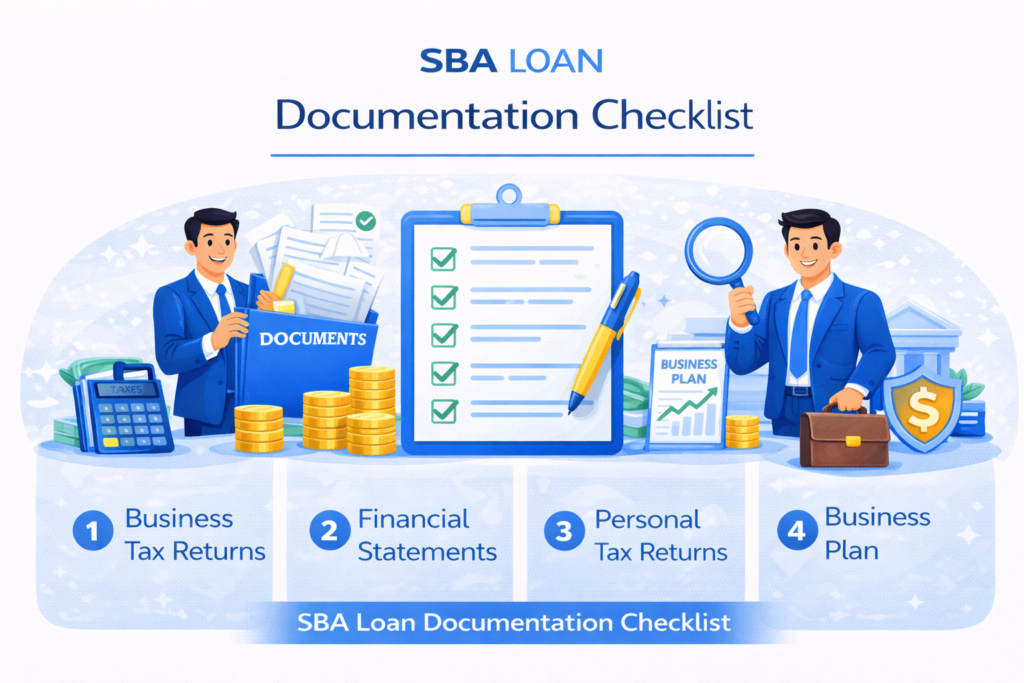
This is the comprehensive list of documents you’ll likely need. Not every lender will require every item, but having all of these ready accelerates your application significantly.
Business Financial Documents
Business Tax Returns (3 years):
- Complete filed business tax returns for last 3 full years
- If you’re self-employed/sole proprietor, you’ll provide personal 1040s with Schedule C attached
Current Business Financial Statements:
- Profit & Loss statement (P&L) from last 3 months and year-to-date
- Balance sheet showing assets, liabilities, and equity
- These should be prepared no more than 90 days before application
Bank Statements (Business Account):
- Last 3-6 months of business bank statements
- All pages (not just summaries)
- Must show account in business name
Accounts Receivable Aging:
- If applicable, list of outstanding customer invoices
- Shows your customer payment behavior and receivables quality
Accounts Payable Aging:
- If applicable, list of business payables
- Shows your payment patterns to suppliers
Business Budget/Projections:
- 3-year financial projections (income statement and cash flow)
- Month-by-month for first year, quarterly for years 2-3
- Should show realistic assumptions and tie to your business plan
Personal Financial Documents
Personal Tax Returns (3 years):
- Complete filed individual tax returns for last 3 years
- All supporting schedules (Schedule C if self-employed, Schedule E if rental income, etc.)
Personal Bank Statements (3-6 months):
- Current checking and savings accounts
- Shows liquid assets and personal cash flow
Personal Balance Sheet:
- A statement of your personal net worth
- Lists personal assets (home, vehicles, investments, savings)
- Lists personal liabilities (mortgage, car loans, credit cards, personal loans)
- Calculated as Assets – Liabilities = Net Worth
Credit Authorization:
- Authorization form allowing lender to pull personal credit reports
- Most lenders require this for all principals (20%+ owners)
Business-Related Legal Documents
Articles of Incorporation/Organization:
- Corporate bylaws or Operating Agreement
- Shows business structure and ownership
Business License(s):
- Copy of current business license
- Industry-specific licenses if applicable (contractor, professional, etc.)
Commercial Lease (if leasing space):
- Copy of current lease agreement
- Shows rent obligation and lease terms
Partnership Agreement (if applicable):
- If business has partners, provides proof of ownership structure
- Shows profit/loss allocation and management roles
Proof of Ownership:
- Partnership agreement, corporate stock certificates, or operating agreement
- Proves your ownership percentage
Collateral Documentation
Real Estate Appraisal (if real estate is collateral):
- Professional appraisal dated within 90 days
- Lender will likely order this, but having one ready helps
Equipment List and Values:
- If using equipment as collateral, list all items and current values
- Include purchase dates and condition
Title Documents:
- If pledging vehicle or equipment, lender may need title documentation
Use of Funds Documentation
Detailed Use of Funds:
- Specific breakdown of how you’ll spend loan proceeds
- For equipment: quotes from vendors showing pricing
- For real estate: purchase agreement or renovation estimates
- For working capital: itemized breakdown of intended uses
Vendor Quotes:
- If purchasing equipment or real estate, include pricing from vendors
- Provides verification of costs and legitimacy of use
Additional Supporting Documents
Business Plan:
- Written business plan (1-5 pages minimum)
- Should cover: business overview, market analysis, competitive positioning, growth strategy, financial assumptions
Resume:
- Curriculum vitae or professional resume
- Shows your business experience and background
Explanation Letters:
- For any credit issues: explanation of late payments, collections, etc.
- For business changes: explanation of ownership changes, acquisition, major pivots
- For income gaps: explanation of unemployment or seasonal business periods
Franchise Documents (if applicable):
- Franchise disclosure document (FDD) if purchasing a franchise
- Franchise agreement
Insurance Documents:
- Proof of existing business liability insurance
- Lender may require insurance before closing
Debt Schedule:
- List of all business and personal debts
- Shows monthly payments and remaining balances
- Critical for lender to assess debt-to-income ratio
Proof of Funds (for equity injection):
- If you’re injecting personal equity into the business
- Bank statements or other proof you have funds available
Industry Certifications (if applicable):
- Professional licenses
- Industry certifications
- Minority/women-owned certifications (can provide SBA benefits)
Organization Tips
Create a Checklist: Use this checklist to ensure you have everything before submitting.
Digital Organization: Create a folder structure in your computer:
SBA_Loan_Application/
├── Personal_Financials/
│   ├── Tax_Returns_3_Years/
│   ├── Bank_Statements/
│   └── Personal_Balance_Sheet/
├── Business_Financials/
│   ├── Tax_Returns_3_Years/
│   ├── YTD_P&L_and_Balance_Sheet/
│   ├── Bank_Statements/
│   └── Projections/
├── Legal_Documents/
├── Use_of_Funds/
└── Supporting_Documents/
Document Naming Convention: Name files clearly: “2025_Tax_Return_Personal_John_Smith.pdf” instead of “doc1.pdf”
Clean Copies: Ensure all documents are:
- Fully legible (not blurry or faded)
- Complete (all pages included)
- In order (chronologically or as requested)
- Clearly labeled with headers/dates
SBA Loan Pros and Cons
Like any financing option, SBA loans come with significant advantages and some meaningful drawbacks. Understanding both sides helps you make an informed decision.
Pros of SBA Loans
Low Interest Rates
The government guarantee allows lenders to offer rates 2-4 percentage points lower than conventional loans. Over a 10-year term, this can save tens of thousands in interest. If you qualify, this is often the single biggest advantage.
Long Repayment Terms
Terms of 10-25 years mean lower monthly payments than you’d get with shorter-term alternatives. This improves cash flow and gives your business breathing room to grow. A $300,000 loan might cost $5,000+ monthly for 5 years but only $3,500+ monthly for 10 years.
Large Loan Amounts
With some programs offering up to $5.5 million, SBA loans can fund major expansions, real estate purchases, or significant equipment acquisitions. Few alternative lenders can compete on loan size.
Builds Business Credit
Responsible management of an SBA loan helps establish your business credit profile (separate from personal credit). This makes future borrowing easier and potentially cheaper. Within 3-5 years of successful repayment, you may qualify for conventional bank loans with even better rates.
Flexible Use of Funds
The 7(a) program allows broad use of funds for working capital, equipment, real estate, inventory, and more. This flexibility means one loan can address multiple business needs.
Available to Borrowers Who Don’t Qualify for Conventional Loans
The 650 credit score minimum and broader acceptance criteria mean borrowers rejected by traditional banks can still access capital. This democratizes lending for small businesses.
Fixed Rates (for 504 loans)
The 504 program offers fixed rates for the entire loan term, protecting you from interest rate increases. Valuable protection if rates spike during your loan term.
Personal Guarantee Protections
While personal guarantees exist, SBA loans generally don’t pursue personal assets as aggressively as some alternative lenders. There’s some reasonableness built into collections.
Cons of SBA Loans
Lengthy Application and Approval Process
30-90 days is normal. If you need capital urgently, SBA loans aren’t the answer. Lenders can take weeks just to review complete applications. If underwriting reveals issues, the timeline stretches further.
Extensive Documentation and Paperwork
SBA lenders want to see everything. Expect to provide 30-40+ pages of financial statements, tax returns, legal documents, and explanations. Disorganized borrowers find this overwhelming.
Strict Underwriting and Requirements
Credit scores under 650 face uphill climbs. Businesses with inconsistent income, recent startup status, or unusual structures face scrutiny. Lenders may reject applications outright without explanation.
Personal Guarantee Required
All principals owning 20%+ must personally guarantee the loan. This means if the business fails, lenders can pursue your personal assets. It’s a serious obligation.
Collateral May Be Required
Most SBA loans require collateral, though requirements are more flexible than conventional loans. If your business lacks assets to pledge, qualification becomes harder.
Not Ideal for Rapid Growth
If you need capital in days or weeks, SBA loans don’t work. The approval timeline means you’ll likely miss time-sensitive opportunities (like a rare equipment deal or urgent building lease).
Limited Flexibility on Terms
Once approved, you can’t easily modify loan terms. If your business needs change, you’re locked in. Refinancing requires another lengthy application.
No Negotiation on Rates Within Programs
Once an SBA program approves a rate formula (Prime + X%), lenders can’t deviate. You can shop between lenders, but you’re locked to the program’s formula.
Personal Asset Liability
Because of the personal guarantee, your home, vehicle, and other personal assets are at risk if the business fails to repay. This is a significant psychological and financial burden.
SBA Loans vs Other Business Loan Options
Not every business should pursue an SBA loan, and not every borrower qualifies. Here’s how SBA loans stack up against other financing options.
SBA Loans vs Traditional Bank Loans
Traditional Bank Loans are conventional business loans from banks without SBA guarantee.
Interest Rates:
- Bank loans: 12-15%
- SBA loans: 10-11.5%
- Winner: SBA (lower by 1.5-4.5%)
Approval Requirements:
- Bank loans: 700+ credit score typical
- SBA loans: 650+ credit score typical
- Winner: SBA (more accessible)
Loan Amount:
- Bank loans: $50K-$500K typical
- SBA loans: Up to $5.5M
- Winner: SBA (larger amounts available)
Approval Timeline:
- Bank loans: 60-90 days typical
- SBA loans: 30-90 days (can overlap)
- Winner: Tie (similar timelines)
Collateral:
- Bank loans: Strict, specific requirements
- SBA loans: Flexible, broader definition
- Winner: SBA (more flexibility)
When Bank Loans Make Sense:
- You have excellent credit (750+) and don’t need SBA-level loan amounts
- You need approval faster than SBA typical timelines
- You have strong personal relationships with local bankers
- You’re borrowing under $100K
SBA Loans vs Online Business Loans
Online Business Loans are short-term, unsecured loans from fintech lenders, often with quick approval.
Interest Rates:
- Online loans: 12-20%+
- SBA loans: 10-11.5%
- Winner: SBA (significantly lower)
Approval Timeline:
- Online loans: 1-3 days
- SBA loans: 30-90 days
- Winner: Online (much faster)
Loan Amount:
- Online loans: $5K-$500K typically
- SBA loans: Up to $5.5M
- Winner: SBA (for large amounts)
Repayment Terms:
- Online loans: 1-5 years
- SBA loans: 5-25 years
- Winner: SBA (much longer, lower payments)
Credit Score Requirements:
- Online loans: 600+ (some as low as 550)
- SBA loans: 650+
- Winner: Online (slightly more accessible to poor credit)
Fees and Costs:
- Online loans: 2-10% origination + high total cost
- SBA loans: 2-3% guarantee fee + lower total cost
- Winner: SBA (lower total cost despite similar fees)
When Online Loans Make Sense:
- You need capital within days
- You need less than $100K
- You don’t qualify for SBA (credit under 650, less than 2 years in business)
- You’re willing to pay higher rates for speed
- You have existing relationships with fintech platforms
SBA Loans vs Merchant Cash Advances (MCA)
MCAs are non-traditional loans where the lender buys a percentage of your future credit card sales, recouped through daily deductions.
Interest Rates/Effective Cost:
- MCAs: 20-40%+ effective annual rates
- SBA loans: 10-11.5%
- Winner: SBA (dramatically lower)
Approval Timeline:
- MCAs: 1-2 days
- SBA loans: 30-90 days
- Winner: MCA (much faster)
Loan Amount:
- MCAs: $5K-$150K typical
- SBA loans: Up to $5.5M
- Winner: SBA (for large amounts)
Repayment Terms:
- MCAs: 3-12 months (daily repayment)
- SBA loans: 5-25 years (monthly payments)
- Winner: SBA (more manageable payment schedule)
Credit Score Requirements:
- MCAs: 500+ (even people with poor credit qualify)
- SBA loans: 650+
- Winner: MCA (more accessible to poor credit)
Debt Burden:
- MCAs: Heavy daily cash flow reduction can hurt business operations
- SBA loans: Fixed monthly payment allows cash flow planning
- Winner: SBA
When MCAs Make Sense:
- You need capital extremely fast
- You have credit below 650 and don’t qualify for SBA
- You have strong daily credit card sales
- You’re willing to pay premium rates for speed
- You need less than $50K
Note on MCAs: While MCAs provide capital quickly, their high effective costs make them expensive. Most financial advisors recommend exploring SBA loans first, even if slower. MCAs should be a last resort for businesses in true emergency situations.
LendWiz specializes in both SBA loans and MCAs, allowing us to match your situation with the best solution. If you’re on the fence between options, our team can help you evaluate tradeoffs.
Decision Framework: Which Loan is Right for You?
Use this decision tree to identify the best financing option:
Step 1: How quickly do you need capital?
- Within 1-2 weeks → Online loan or MCA
- Within 1-2 months → SBA Express
- Can wait 2-3 months → Standard SBA loan
Step 2: What’s your credit score?
- Below 650 → Online loan or MCA
- 650-700 → SBA loan is realistic
- 700+ → Bank loan or SBA with best rates
Step 3: How much do you need?
- Under $50K → Microloan, online loan, or small SBA
- $50K-$500K → SBA or online loan
- Over $500K → SBA is likely only option
Step 4: How long can you commit to repayment?
- 1-2 years → Online loan or MCA
- 5-10 years → SBA 7(a) or 504
- 10+ years → SBA 504 for real estate
Step 5: What’s your business age?
- Less than 2 years → Microloan or online loan
- 2+ years → SBA is strong option
- 5+ years with strong track record → Bank loan viable
Tips to Improve Your SBA Loan Approval Odds
Even if you’re close to SBA requirements, these strategies increase your approval likelihood and may improve the rates you’re offered.
Develop a Strong Business Plan
A professional business plan shows lenders you’ve thought through your strategy. It doesn’t need to be a novel—5-10 pages is sufficient.
What to Include:
- Executive Summary: One-paragraph overview of your business, loan request, and use of funds
- Market Analysis: Industry overview and target customer definition
- Competitive Landscape: Who are your competitors and why are you different?
- Marketing Strategy: How will you acquire and retain customers?
- Financial Assumptions: Realistic revenue, expense, and growth projections
- Management Team: Your experience and the experience of key team members
- Use of Funds: Detailed allocation of borrowed capital
Pro Tip: If you lack business plan writing experience, use free SBA templates (SBA.gov) or affordable services like SCORE (free mentoring organization). Your business plan is your sales document to the lender.
Clean Up and Strengthen Your Financial Statements
Lenders scrutinize your financials intensely. Weaknesses here are major red flags.
What to Do:
- Ensure your tax returns match your business accounting records
- Reconcile business bank account statements
- If your P&L and tax returns don’t match, explain discrepancies
- Make sure financial statements are prepared by an accountant if possible
- Ensure all numbers are consistent across documents
What to Avoid:
- Inconsistencies between tax returns and bank statements
- Unexplained large cash deposits or withdrawals
- Unusual transactions or payments
- Deteriorating financial trends without explanation
Work with an Experienced SBA Lender
Not all SBA-approved lenders are equal. Some have deep experience with your industry; others are more conservative; some have niche expertise (startups, minority-owned businesses, etc.).
Questions to Ask Potential Lenders:
- How many SBA loans do you close annually?
- What’s your approval rate and typical timeline?
- Do you have experience with businesses like mine?
- What documentation do you require?
- Can you provide references from recent clients?
- What’s your approach if we hit underwriting issues?
Why It Matters: Experienced lenders move faster, know how to package borderline applications, and can often approve loans that more conservative lenders would decline.
Start the Process Early
Don’t wait until you’re in crisis to pursue an SBA loan. Starting 3-4 months before you need capital gives you time to:
- Assemble documentation carefully
- Address any credit issues
- Shop multiple lenders
- Navigate unexpected underwriting requests
- Plan your capital deployment strategically
Starting early also means you’re not desperate when negotiating, which puts you in a better position.
Consider SBA Express for Speed
If you need capital within 30-45 days and borrowing $500K or less, SBA Express can deliver. The slightly higher rate (often 0.25-0.5% more than standard 7(a)) is worth it if timing is critical.
Get Help from SBA Resources
The SBA offers free counseling through SCORE mentors and Small Business Development Centers (SBDCs). These resources can:
- Help you develop your business plan
- Review your financial statements
- Connect you with lenders
- Answer questions about requirements
Use these free resources. They exist specifically to help people like you.
How LendWiz Can Help You Get an SBA Loan
Navigating the SBA loan landscape alone is challenging. That’s where LendWiz comes in.
Navigate the Complex SBA Process
The SBA loan ecosystem is intricate. Different loan programs have different rules. Documentation requirements vary. Lender preferences differ. LendWiz has been helping businesses secure SBA financing for over a decade. We understand:
- Which loan program matches your situation
- What documentation each lender wants
- How to position your application for the strongest approval odds
- How to address underwriting issues when they arise
- How to negotiate terms and rates
Our expertise saves you time and helps you avoid costly mistakes.
Connect You with SBA-Approved Lenders
LendWiz maintains relationships with dozens of SBA-approved lenders—from regional banks to credit unions to specialized online SBA platforms. Rather than cold-calling lenders yourself, we match you with lenders:
- Experienced with your business type
- Aligned with your timeline
- Competitive on rates and fees
- Known for responsive service
We submit your application to multiple lenders simultaneously, creating competitive tension that often drives better terms for you.
Explore Alternative Options if You Don’t Qualify for SBA
If your credit is below 650, your business is less than 2 years old, or you don’t qualify for SBA for other reasons, don’t worry. LendWiz also offers:
- Unsecured Business Loans: For borrowers with good credit who want to skip collateral requirements. Learn more at /unsecured-business-loans/
- Bad Credit Business Loans: Specifically designed for borrowers with credit below 650. Explore options at /bad-credit-business-loans/
- Business Lines of Credit: Flexible credit lines for working capital needs. Details available at /business-line-of-credit/
- Merchant Cash Advances: For businesses needing capital urgently with strong credit card sales. MCAs provide funding in days when traditional lenders take weeks.
We evaluate your situation holistically and recommend the best option—whether that’s an SBA loan or an alternative product better suited to your circumstances.
Dedicated Support Throughout the Process
From initial consultation through funding, LendWiz provides support:
- Pre-qualification calls to confirm SBA eligibility
- Application guidance to ensure you submit complete, professional packages
- Lender coordination to track application progress
- Underwriting support to address requests and clarifications
- Closing coordination to move documents and complete funding
You’re not navigating this alone. We’re with you every step.
Frequently Asked Questions About SBA Loans
Q1: What’s the difference between a 7(a) and 504 loan?
A: The main differences are purpose and structure. A 7(a) loan is flexible and can be used for various business purposes (working capital, equipment, real estate, etc.). A 504 loan is specifically for real estate and equipment with a two-tier structure. The 504’s fixed rates and longer terms make it ideal for real estate; the 7(a)’s flexibility makes it ideal for general business use.
Q2: How long does an SBA loan application take?
A: Typically 30-90 days from application to funding. This includes 5-15 days for document gathering, 5-15 days for underwriting, 5-20 days for any clarifications or conditions, and 2-5 days for closing and funding. SBA Express can be faster (24-36 days). Complex applications take longer.
Q3: Can I use an SBA loan to pay off existing debt?
A: Yes. Many 7(a) loans allow debt refinancing, especially if you’re using the freed-up cash flow for business purposes. However, the SBA limits refinancing to situations where it benefits the business and supports growth. You can’t simply refinance personal debt or non-business obligations.
Q4: Do I need collateral for an SBA loan?
A: Usually, but it’s flexible. The SBA allows lenders to make loans based on the strength of your business and credit even if collateral is limited. Your business assets, equipment, real estate, and accounts receivable may serve as collateral. Microloans often have more flexible collateral requirements than 7(a) loans.
Q5: What credit score do I need for an SBA loan?
A: Most lenders require 650+, though some work down to 620. Lower scores don’t disqualify you, but they make approval harder and rates higher. A score of 680+ significantly improves approval odds. If your score is below 650, consider credit-building strategies before applying.
Q6: Can startups get SBA loans?
A: Startups generally don’t qualify for 7(a) loans (which require 2+ years in business). However, SBA Microloans are specifically designed for startups. Additionally, some lenders make exceptions for startups with strong business plans, personal capital injection, and relevant industry experience.
Q7: How much does an SBA loan cost?
A: This depends on the loan size, type, and terms. A $250,000 7(a) loan at 11% over 10 years costs approximately $3,772/month. Total interest is about $200,000. The SBA guarantee fee (typically 2%) reduces your initial funding by about $5,000. Total cost (interest + fees) is around $205,000 above principal, but this is still less expensive than most alternative loan types.
Q8: Can I pay off an SBA loan early?
A: Yes, without prepayment penalties. You can pay off your SBA loan anytime without triggering fees. If you pay off early, you’ll save on total interest paid, though you’ll lose the benefit of spreading payments over a longer period.
Q9: What if I’m denied for an SBA loan?
A: Don’t give up. You have options: apply with a different lender (underwriting varies), address the specific issues the lender raised (credit repair, additional collateral, business plan revision), or explore alternative financing (unsecured loans, bad credit loans, MCAs). Contact LendWiz to discuss your specific situation.
Q10: How do SBA loan rates compare to conventional bank loans right now?
A: As of 2026, SBA 7(a) loan rates are typically 10.5-11.5%, while conventional bank loans are 12-15%. SBA 504 loans are fixed, typically 7.5-8.5%. These are significantly lower than online business loans (12-20%) and MCAs (20-40%+). If you qualify for SBA, the rate advantage alone makes it worth pursuing.
Get Started with Your SBA Loan Application
You’ve learned about SBA loan types, requirements, rates, application processes, and how SBA loans compare to alternative financing. Now it’s time to take action.
Start Your SBA Loan Journey
Step 1: Schedule a Free Consultation
Contact LendWiz for a free, no-obligation consultation with one of our SBA specialists. We’ll ask about your business, financial situation, and capital needs, then tell you honestly whether an SBA loan is the best path forward.
Step 2: Get Pre-Qualified
We’ll run a quick credit check and review your basic financials to confirm you’re likely to qualify. This takes 24-48 hours and comes with a preliminary rate estimate.
Step 3: Gather Your Documents
Use the documentation checklist we provided earlier. Have questions about a specific document? Our team will guide you.
Step 4: Let Us Handle the Rest
We’ll package your application, submit to multiple SBA-approved lenders, coordinate underwriting, and guide you through to closing.
Why Choose LendWiz for Your SBA Loan?
- Expertise: Over a decade helping businesses secure SBA financing
- Network: Relationships with dozens of SBA-approved lenders
- Speed: We streamline the process to close as quickly as possible
- Flexibility: If SBA doesn’t work, we offer alternative financing options
- Support: Dedicated guidance from application through funding
Take the Next Step Today
Whether you’re exploring SBA loans for the first time or ready to move forward with an application, LendWiz is here to help. Every day you wait is a day you’re not growing your business with the capital you need.
Contact LendWiz today to discuss your SBA loan options.
Your business deserves the capital to reach its potential. Let’s make it happen.