

In business, timing is everything. Whether it’s a seasonal surge in demand, an unexpected equipment failure, or a time-sensitive opportunity to grow, the businesses that move fast often win. But traditional bank loans take weeks or months to approve, leaving you stuck watching opportunities pass by or scrambling to cover unexpected costs.
This is where short term business loans come in. They’re designed for real-world business needs that can’t wait. You need cash now—not in 90 days when a bank finally gets around to reviewing your application.
Short term business loans provide rapid funding with flexible terms that work around your business cycle. Whether you’re a seasonal business that needs cash flow during slow months, a growing company that needs bridge financing between revenue cycles, or an established business facing an unexpected emergency, these loans can be the difference between seizing an opportunity and losing it.
In this guide, we’ll walk you through everything you need to know about short term business loans. We’ll cover how they work, the different types available, real-world scenarios where they make sense, and how to find the right funding partner to get you cash when you need it most. By the end, you’ll understand whether short term financing is right for your business and how to access it quickly.
What Are Short Term Business Loans?
Short term business loans are financing options designed to get cash into your business quickly, typically within days rather than weeks or months. Unlike traditional bank loans that might have terms of five years or longer, short term business loans usually have repayment periods between 3 and 18 months.
Here’s the key difference: traditional loans focus on your creditworthiness and lengthy approval processes. Short term business loans focus on your business’s cash flow and ability to repay. Lenders evaluate your business operations, revenue, and cash flow rather than just your personal credit score. This approach makes funding accessible to more business owners and dramatically speeds up the approval process.
Typical Short Term Loan Characteristics:
- Fast approval: 24 to 48 hours (sometimes same-day)
- Quick funding: Cash in your account within days
- Flexible terms: 3 to 18 months typically
- Flexible amounts: $5,000 to $500,000+ depending on your business
- Less stringent requirements: Easier approval than traditional bank loans
- Relationship-focused: Many lenders work with you personally
Short term business loans are ideal for business owners who need working capital quickly. They’re particularly suited for companies with consistent revenue but temporary cash flow challenges, seasonal businesses, growing companies, or businesses with irregular payment cycles from customers.
How Short Term Business Loans Work
Understanding the process helps you prepare and speeds up your application. Here’s how short term business loans typically work from start to finish.
The Application Process
You begin by providing basic information about your business: how long you’ve been operating, your approximate annual revenue, what you need the money for, and how much you need. Most lenders have online applications that take 15-30 minutes to complete. You’ll provide basic documentation like recent bank statements, tax returns, and proof of business license.
Lender Evaluation
Unlike banks that focus heavily on personal credit scores, short term lenders evaluate your business differently. They look at:
- Monthly revenue: How much your business brings in
- Bank statements: Your actual cash flow over the past 3-6 months
- Time in business: Most require at least 6 months to 1 year
- Industry: Some industries are considered higher risk
- Debt obligations: Your existing loans and obligations
- Business purpose: What you’ll use the money for
Notably, many short term lenders don’t require a perfect credit score. Some work with business owners who have credit challenges because they evaluate your business’s ability to generate cash, not just your personal credit history.
Approval Timeline
Once you submit your application, the lender reviews it—often within 24 hours. Many provide conditional approval the same day. If approved, you move to the final stage.
Funding
After final approval, money transfers to your business account. Depending on the lender and type of loan, this can happen within 24-48 hours, or in some cases the same business day.
Repayment
Short term loans typically have daily, weekly, or monthly payments. Daily or weekly payments are common with merchant cash advances and some short term loans, as they tie to your business’s cash flow. If you have a good day, you pay a bit more; if business is slow, your payment adjusts. Monthly payments are more traditional and easier to budget for.
Types of Short Term Business Loans
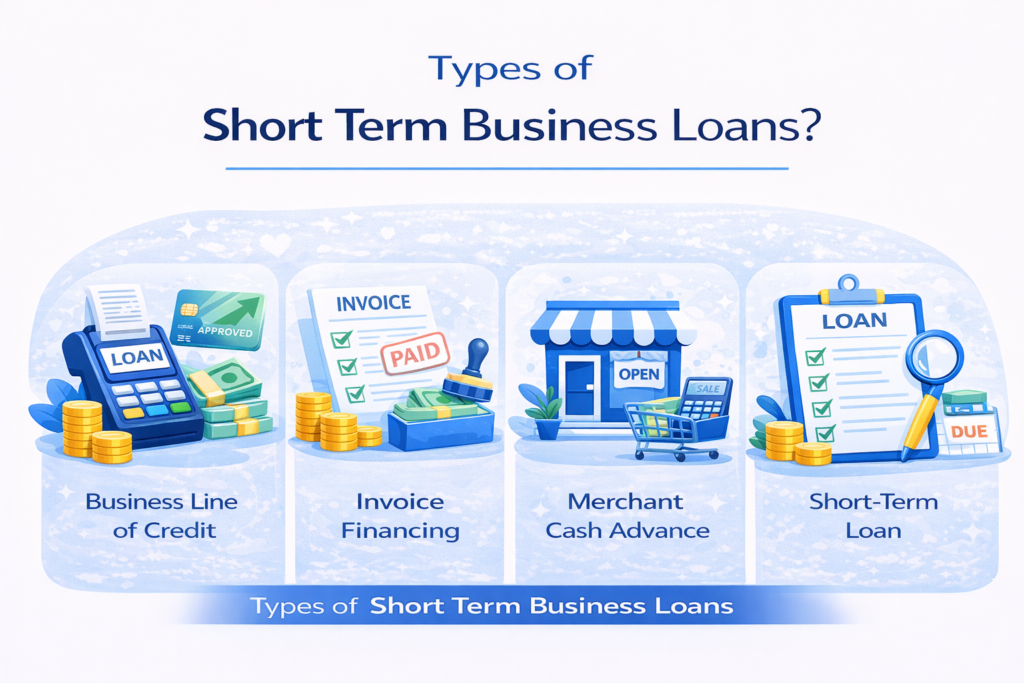
Not all short term funding is the same. Here are the main options available:
Merchant Cash Advances (MCAs)
An MCA is an advance against your future credit and debit card sales. Instead of borrowing a set amount with fixed payments, you receive an upfront cash amount (called the advance), and the lender takes a percentage of your daily card sales until the advance plus fees is repaid.
How it works: You receive $25,000 today. The lender takes 10% of your daily card sales until they’ve recovered their money plus profit. On days you do $2,000 in card sales, they take $200. On slow days, they take less.
Typical terms: 3 to 12 months, though repayment depends on sales volume
Best for: Retail businesses, restaurants, salons, and service businesses with high daily card transactions
Pros: Flexible repayment that matches your sales, quick approval, works for businesses with less-than-perfect credit
Cons: Can be expensive if business is strong, requires consistent card sales
Short Term Loans
These are traditional installment loans with fixed terms and fixed payment amounts, but compressed into shorter repayment periods.
How it works: You borrow $30,000 and repay it over 12 months with fixed monthly payments of approximately $2,500 plus interest and fees.
Typical terms: 6 to 18 months
Best for: Businesses that want predictable payments and steady revenue
Pros: Predictable payments, competitive rates among short term options, simple to understand and budget for
Cons: Less flexible than MCAs, fixed payments regardless of business performance
Business Line of Credit
A line of credit is like a credit card for your business. You’re approved for a maximum credit limit, and you only pay interest on what you use.
How it works: You’re approved for a $50,000 line of credit. You draw $15,000 when you need it and only pay interest on that $15,000. As you repay, you can borrow again.
Typical terms: Revolving credit, variable interest rates
Best for: Businesses with unpredictable cash needs, seasonal businesses, growing businesses that need flexibility
Pros: Only pay for what you use, can access funds quickly once approved, flexible amount, great for ongoing cash needs
Cons: Typically higher interest rates than term loans, requires discipline not to over-borrow
Invoice Factoring
Invoice factoring is selling your unpaid invoices to a lender at a discount. You get immediate cash instead of waiting 30-60 days for customer payment.
How it works: Your customers owe you $50,000. You sell these invoices to a factor for $47,500 (keeping $2,500 less as the fee). You get the cash immediately; the factor collects from your customers.
Typical terms: 30 to 90 days (matching customer payment terms)
Best for: B2B businesses with reliable customers and regular invoices, service businesses with long payment terms
Pros: Immediate cash, doesn’t create debt on your balance sheet, payments automatically decrease as invoices are paid
Cons: Can be expensive if used long-term, requires customer awareness, customer payment risk transfers to you
Bridge Loans
A bridge loan is short term financing that “bridges” a gap between now and when you expect a larger funding event or cash influx.
How it works: You’re waiting for a government contract worth $200,000, but approval takes 90 days. You need $30,000 now to cover operating costs and payroll. A bridge loan covers those 90 days, then you repay from the contract funds.
Typical terms: 3 to 12 months
Best for: Businesses waiting for major deals, ventures preparing to close investment rounds, or situations with a clear future cash source
Pros: Temporary solution for a specific problem, repayment clear at loan creation, often have favorable terms if future cash is guaranteed
Cons: Still requires repayment if the anticipated funds don’t materialize, can be expensive
When to Use a Short Term Business Loan
Short term business loans excel in specific situations. Let’s look at real-world scenarios where they make perfect sense:
Seasonal Cash Flow Gaps
You run a landscaping business. You’re profitable, but winter is dead. You have plenty of work lined up for spring, but you need to cover payroll and equipment maintenance through February and March. A short term loan gets you through the slow season, and you repay easily in the spring when revenue returns.
Emergency Equipment Repairs
Your commercial kitchen’s refrigerator fails. You can’t operate without it. A new one costs $8,000, and you need it today. A traditional bank loan would take six weeks to approve. A short term loan covers the cost immediately, getting your business back online.
Inventory for a Major Order
A big client wants to order $50,000 worth of your products—the largest order in your company’s history. But you need $15,000 in inventory upfront to fulfill it. You can’t wait for a bank loan. A short term business loan funds your inventory now, you fulfill the order, get paid, and repay the loan immediately.
Bridge Between Invoice Payments
You’re a consulting firm with net-30 payment terms. You just completed a $40,000 project but won’t get paid for 30 days. Meanwhile, you need to pay your team $20,000 in salaries this Friday. Invoice factoring or a short term loan bridges that gap.
Growth Opportunity
A vendor is offering a limited-time discount on your raw materials—20% off but only if you order this month. The bulk purchase would cost $25,000 but save you $5,000 per month in ongoing costs. You don’t have $25,000 in cash right now, but a short term loan makes the math work. You’re profitable again in 5 months.
Marketing Campaign Launch
You’ve identified an opportunity to grow into a new market. You need $12,000 upfront for digital advertising to test the market. Expected revenue from the campaign is $4,000/month once it gains traction. A short term loan funds the initial spend, and the new revenue covers repayment.
Payroll Coverage During Slow Period
Your business has temporary staffing needs during peak season. You need to hire contractors or temporary workers for six weeks, which costs $18,000, but you don’t have that cash available. A short term loan covers the cost, and the increased productivity from additional hands leads to the revenue needed to repay it.
Time-Sensitive Licensing or Permits
You found the perfect location for a second location, but you need to move fast. The deposits and licenses cost $10,000 to secure. A traditional loan takes too long; a short term loan lets you lock in the space and get the licenses while the opportunity is available.
The pattern here is clear: short term business loans work best when you have a specific, temporary need with a clear path to repayment.
Short Term Business Loan Rates & Costs
Cost is the most important factor when evaluating short term funding. Understanding how rates work and calculating true costs helps you make informed decisions.
Rate Types
Short term loans typically use two different rate structures:
APR (Annual Percentage Rate): This is what you’re familiar with from traditional loans. A 10% APR means 10% per year. For short term loans, this is useful for comparison, but actual cost depends on the loan term.
Factor Rate: Particularly common with MCAs and short term loans, a factor rate is simpler but looks higher. A 1.25 factor rate means you borrow $10,000 and repay $12,500 ($10,000 × 1.25). The cost is the difference. To convert a factor rate to approximate APR, subtract 1, multiply by 365, divide by the loan term in days. So 1.25 for a 6-month loan is approximately 61% APR.
Rate Ranges by Loan Type
Here’s what you typically see:
| Loan Type | Rate Range | Term |
|---|---|---|
| Business Line of Credit | 7-30% APR | Revolving |
| Short Term Loans | 10-80% APR | 6-18 months |
| Merchant Cash Advances | 1.1-1.5 factor | 3-12 months |
| Invoice Factoring | 1-3% of invoice value | 30-90 days |
| Bridge Loans | 8-25% APR | 3-12 months |
Total Cost Calculation
The true cost of a loan includes more than the interest rate. Here’s what to factor in:
- Interest/factor charges: The main cost
- Origination fees: Usually 1-5% of the loan amount
- Processing fees: Varies, typically $200-$500
- Administrative fees: Some lenders charge monthly maintenance fees
Let’s look at an example. You’re borrowing $20,000:
- Interest (10% APR for 12 months): $2,000
- Origination fee (3%): $600
- Processing fee: $300
- Monthly admin fee ($50 × 12): $600
- Total cost: $3,500
- True APR with all fees: 17.5%
Always calculate the complete cost, not just the headline rate.
Cost Comparison Example
Let’s say you need $30,000 for six months:
Option 1: 12% APR Short Term Loan
- Total repayment: $31,800 ($30,000 + $1,800 in interest)
- Monthly payment: $5,300
Option 2: 1.3 Factor MCA
- Total repayment: $39,000 ($30,000 × 1.3)
- Daily payment: ~$640 (varies with sales)
Option 3: Business Line of Credit at 18% APR
- Total repayment: $30,000 (only pay interest on what you use)
- Interest: $2,700 if you use the full amount for 6 months
- Monthly payment: Variable
The best option depends on your cash flow predictability. If your revenue is stable, the 12% APR loan is cheapest. If your revenue fluctuates, the MCA’s flexible payment might be worth the extra cost.
Requirements & How to Qualify
What does it take to qualify for a short term business loan? The good news: the requirements are typically much simpler than traditional bank loans.
Standard Requirements
Most short term lenders require:
- Time in business: At least 6 months to 1 year (some lenders accept 3-6 months)
- Annual revenue: Minimum $50,000 to $100,000 annually (varies by lender and loan type)
- Business formation: Valid business license, registered business entity
- Bank account: Active business bank account with 3-6 months of history
- Personal credit score: Not always required, but many lenders prefer 550+
- Ownership documentation: Proof that you own/control the business
- Valid ID: Personal identification for the owner(s)
Documentation Checklist
Here’s what you’ll typically need to gather before applying:
- Personal tax returns (last 2 years)
- Business tax returns (last 2 years if available)
- Recent bank statements (last 3-6 months)
- Business license or registration
- Personal ID
- Details on what you’ll use the money for
- Information on existing business debt
How to Improve Your Chances
Even if you don’t meet all requirements perfectly, here are ways to strengthen your application:
Build positive bank history: Maintain a healthy business bank account. Lenders look for consistent deposits and low overdraft activity. Even three months of clean statements helps.
Reduce existing debt: If you have personal or business loans, make all payments on time. Lenders want to see you’re responsible with credit.
Document your business: Keep organized records. If you’re self-employed or a solopreneur, document your income clearly through bank deposits, invoices, and tax records.
Prepare a use-of-funds explanation: Lenders appreciate knowing exactly what you’ll do with the money and how it will help the business. “Equipment purchase” or “inventory for confirmed order” is much stronger than “general business needs.”
Improve personal credit if necessary: If your personal credit is under 550, work on it before applying. Pay down personal debt, correct errors on your credit report, and make all payments on time for several months.
Choose the right lender: Different lenders have different standards. Some specialize in businesses with credit challenges. Some focus on specific industries. Find lenders that work with businesses like yours.
Short Term vs Long Term Business Loans
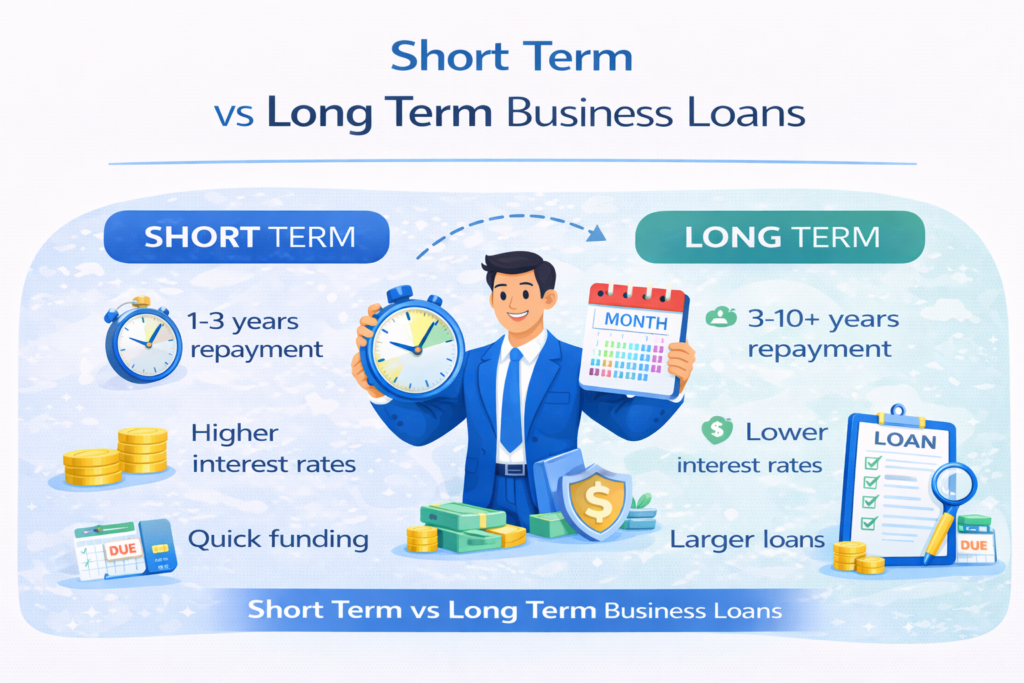
How do short term and long term business loans actually differ, and which is right for your situation? Here’s a detailed comparison:
Speed to Funding
Short term loans typically close in 24-48 hours. Long term bank loans usually take 2-8 weeks. If you need money urgently, short term wins decisively.
Approval Flexibility
Short term lenders focus on your business’s current cash flow. Long term bank lenders focus on credit scores, collateral, and extensive documentation. If you have credit challenges, short term loans are more accessible.
Cost Comparison
Short term loans appear expensive because they’re calculated for short periods. Let’s compare two scenarios:
Scenario: 12-month $30,000 loan
- Short term loan at 15% APR: $4,500 interest
- Bank loan at 8% APR: $2,400 interest
- Short term is $2,100 more expensive
Scenario: 60-month $30,000 loan
- Bank loan at 8% APR: $6,408 interest
- Short term loan (if you could get one): ~$15,000+ in interest by doing multiple sequential short-term loans
Short term loans are most cost-effective for actual short-term needs. If you need money for five years, a long-term bank loan is cheaper.
Payment Flexibility
Short term loans (especially MCAs) often have flexible payment structures tied to your cash flow. Bank loans have fixed payments regardless of business performance.
Debt Impact
Bank loans add to your balance sheet debt, which affects your debt-to-income ratio for future financing. Some short term options (like factoring) don’t create traditional debt.
Renewal and Flexibility
Bank loans are set for a specific term. Short term loans can often be renewed or refinanced if needed.
| Factor | Short Term | Long Term |
|---|---|---|
| Speed | 1-3 days | 2-8 weeks |
| Cost | Higher for extended use | Lower overall |
| Credit Requirements | Flexible | Strict |
| Payment Flexibility | High (often) | Fixed |
| Best For | Temporary needs | Long-term projects |
| Debt Impact | Lower | Higher |
When to Choose Short Term Loans
- You need cash urgently (within days)
- You have a specific, temporary cash need
- You have credit challenges
- You want flexible repayment tied to business cycles
- You’re bootstrapping and want to minimize debt
- You’re unsure about long-term needs
When to Choose Long Term Loans
- You need funds for a long-term project (5+ years)
- You want the lowest total cost
- You have strong credit
- You want fixed, predictable payments
- You’re making a major capital investment
- You’re building long-term business infrastructure
Same Day Business Loans: How to Get Funded Fast
Some business emergencies can’t wait. If you need cash today, not tomorrow or next week, same-day business loans exist—but you need to know how to access them.
Which Loan Types Offer Same-Day Funding?
Not all short term loans offer same-day funding. Here’s what’s realistically possible:
Merchant Cash Advances: Most MCAs can fund within 24 hours with same-day approval. Some specialized lenders offering funding in 4-6 hours for existing customers.
Short Term Loans (with approved lenders): Some online lenders approve and fund within 24 hours, though same-day is rare. Some lenders offer same-day to existing customers.
Business Line of Credit: Once approved, you can often draw funds same-day. Initial approval takes longer.
Invoice Factoring: Can fund same-day once you’ve submitted qualifying invoices.
What You Need to Have Ready
To qualify for same-day funding, preparation is critical. Have these items available before you apply:
- Personal identification (driver’s license, passport)
- Business license
- Last 3-6 months of business bank statements (ideally PDF)
- Recent personal tax returns
- Business formation documents
- Ownership verification
- Clear explanation of what funds are for
- Contact information for references (prior lenders, business relationships)
The Same-Day Application Process
- Find the right lender: Research lenders that specifically offer same-day funding. Check reviews and verify they deliver.
- Complete online application: Most take 20-30 minutes. Be accurate and complete.
- Submit documentation: Upload statements and ID immediately. Don’t wait.
- Be available: Keep your phone nearby. Lenders may have quick questions.
- Provide banking information: Have your business bank account details ready for fund transfer.
- Review and approve: Once offer is presented, carefully review terms and approve quickly.
- Final verification: Some lenders do a quick call to verify ownership. Answer immediately.
- Fund transfer: Funds typically deposit 1-4 hours after approval (depending on bank processing speed).
How LendWiz Provides Fast-Track Funding
At LendWiz, we’ve streamlined the entire process. Our same-day funding for short term business loans works like this:
- Online application: 15 minutes from any device
- Instant pre-qualification: See estimated terms immediately
- Document upload: Simple portal for bank statements and ID
- Quick review: Typically within 1 business hour
- Same-day approval: Most approvals within 2-4 hours
- Same-day funding: Money deposited by end of business day for morning applications
We focus on businesses and cash flow, not credit scores, which is why we can move faster than traditional lenders.
How to Get a Short Term Business Loan with LendWiz
Getting approved for short term business funding with LendWiz is straightforward. Here’s our three-step process:
Step 1: Get Pre-Qualified (5 Minutes)
Answer basic questions about your business: how long you’ve been operating, your approximate monthly revenue, and how much you need. Our system instantly shows you estimated loan amounts and rates you might qualify for—with no impact to your credit score. This is just an estimate to show you what’s possible.
Step 2: Complete Your Application (15 Minutes)
Provide detailed information about your business and the owner(s). Upload recent bank statements and ID. Be thorough and accurate—this determines your actual rate and terms. Our application is mobile-friendly, so you can complete it from anywhere.
Step 3: Receive Your Offer (1-4 Hours)
Our team reviews your application and contacts you with a final offer. We’ll explain your exact rates, terms, monthly payments, and total cost. If you accept, funds deposit to your business account—often the same business day.
Why LendWiz Is Different
We focus on your business, not your personal credit score. We look at:
- Your actual business revenue
- Your real cash flow (from bank statements)
- What you’ll use the money for
- Your ability to generate revenue to repay
Most business owners who can’t qualify for traditional bank loans get approved with LendWiz because we understand that a successful business can thrive even with imperfect personal credit.
We also offer:
- Multiple loan types: Choose what fits your business best
- Flexible terms: 3 to 18 months, pick what works
- Clear pricing: No surprise fees, everything upfront
- Personal service: Talk to a real person, not a chatbot
- Fast funding: Same-day approval and funding in most cases
Our goal is to be your funding partner as your business grows—not a lender you use once and forget.
Frequently Asked Questions About Short Term Business Loans
1. Can I get a short term business loan with bad credit?
Yes. Most short term lenders, including LendWiz, don’t require perfect credit. We evaluate your business’s revenue and cash flow, not just your personal credit score. Many business owners with credit challenges of 550-650 qualify for funding. Some lenders work with even lower scores, though terms may be less favorable.
2. How fast can I really get funded?
Approval can happen same-day (2-4 hours for many lenders). Funding typically arrives within 24 hours after approval, sometimes same-day. The speed depends on your bank’s processing time. Morning applications are most likely to fund same-day.
3. What if my business has inconsistent income?
Inconsistent income is actually expected with seasonal businesses and service providers. Lenders look at your average monthly income over time. If you can show good months and bad months average out to a sustainable level, you’ll likely qualify. Merchant cash advances are particularly good for inconsistent income because payments adjust to your sales.
4. Do I need collateral for a short term business loan?
Usually no. Most short term lenders offer unsecured loans, meaning you don’t need to put up equipment or property as collateral. This is one advantage over traditional bank loans. Some large loans might require collateral, but smaller short term loans typically don’t.
5. What happens if I pay off my loan early?
Most short term lenders allow early payoff without penalties. This is a huge benefit—if your business does well and you want to pay off the loan early and be done, you can. Always confirm the lender has no early payoff penalties.
6. Can I get multiple short term loans at once?
Technically yes, but it’s not advisable. Multiple short term loans create multiple monthly payments, which strains your cash flow. If you need more than one lender’s maximum, first try to increase the first loan amount, or consider a larger business line of credit that can cover multiple needs.
7. How much can I borrow with a short term business loan?
Typical ranges are $5,000 to $500,000, depending on your business revenue, the lender, and the loan type. Lenders typically cap loans at a percentage of your annual revenue—often 10-50% depending on the type. A business with $500,000 annual revenue might qualify for $50,000-$250,000 depending on how it’s structured.
8. What’s the difference between a short term business loan and a personal loan?
Business loans are evaluated based on business revenue and cash flow. Personal loans are based on personal credit and income. If you’re a business owner, a business loan is almost always better because it doesn’t require perfect personal credit and doesn’t count against your personal borrowing capacity.
Ready for Fast Funding? Apply with LendWiz Today
If you’ve recognized that your business needs short term funding, you’re in the right place. LendWiz specializes in getting capital to businesses quickly, with rates that reflect your actual business situation—not arbitrary credit scores.
Whether you need to cover seasonal cash flow gaps, fund emergency repairs, take advantage of a growth opportunity, or bridge the gap between invoicing and payment, short term business loans can be the solution.
Our team is ready to help you get approved for the funding you need. We focus on your business, work quickly, and provide the clear pricing and personal service that larger lenders simply can’t match.
Ready to move forward? Here’s what to do:
- Start your pre-qualification: It takes 5 minutes and doesn’t affect your credit. You’ll see instantly what you might qualify for.
- Upload your documents: The faster you provide bank statements and ID, the faster we can move.
- Get your offer: Our team will contact you within hours with your exact terms and rate.
- Get funded: Accept your offer and receive funds the same business day in most cases.
Don’t let cash flow challenges hold your business back. Explore unsecured business loans, merchant cash advances, and working capital loans options with LendWiz today.
Your business deserves funding that moves as fast as you do.